To test hormone levels in women, time the blood draw to the menstrual cycle: FSH, LH and estradiol early in the cycle, and progesterone about a week before the next period. Then read those results with thyroid, insulin and cortisol, because one draw on an unplanned day can land anywhere in a changing cycle.
When in Your Cycle Should Hormones Be Tested?
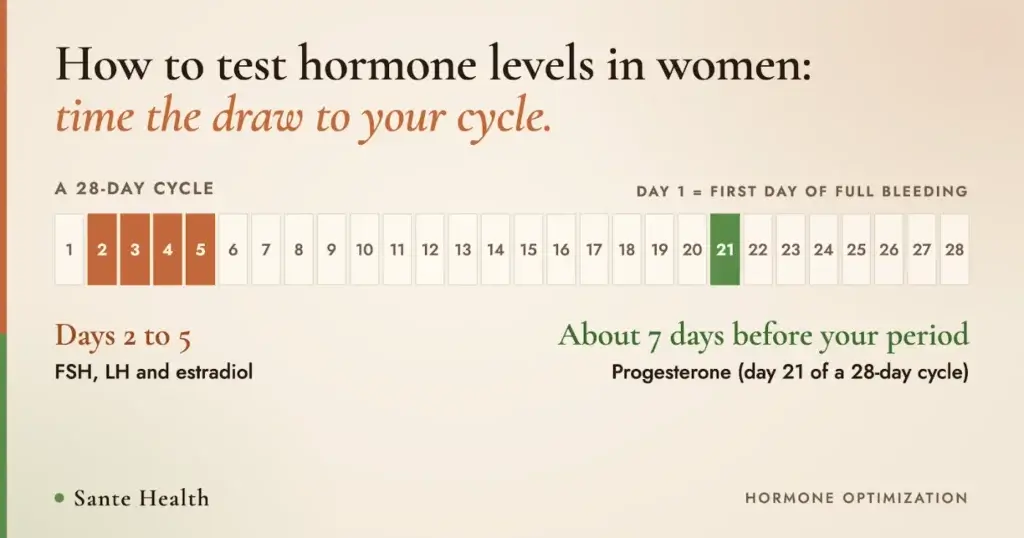
Each hormone has its own window. For the sex hormones, count from day 1, the first day of full bleeding:
| Hormone | When to draw | What the result shows |
|---|---|---|
| FSH, LH and estradiol | Days 2 to 5 | A baseline taken while estradiol and progesterone are at their lowest |
| Progesterone | About 7 days before the next expected period (day 21 of a 28-day cycle) | Whether ovulation happened that cycle |
| Fasting insulin and glucose | A morning draw after an overnight fast | How much insulin the body needs at rest |
| Cortisol | Early morning | The daily high point, which a later draw misses |
The progesterone window moves with cycle length. In a 32-day cycle it falls around day 25, so counting back from the expected period works better than using day 21 for everyone. When cycles are irregular or have stopped, the clinician ordering the panel sets the timing instead.
Write the draw date and cycle day on the lab order or in your notes. A progesterone result means little without the day it was drawn.
Does Birth Control Change Hormone Test Results?
Combined hormonal contraception suppresses the body’s own cycle, so estradiol and progesterone read low and stay that way through the pill-free week. FSH and LH are suppressed as well. NICE guideline NG23 advises against using an FSH test to identify menopause in anyone using combined estrogen and progestogen contraception or a high-dose progestogen.
Tell whoever orders your panel exactly what you take, including a hormonal IUD, an implant or hormone therapy, so the results are read against it. Keep taking your medications unless your clinician tells you otherwise.
Why Can’t One FSH Test Show Where You Are in Perimenopause?
FSH and estradiol swing from cycle to cycle in perimenopause, so a single value describes only the day it was drawn. That is why NICE guideline NG23, updated in 2024, identifies perimenopause and menopause in women 45 and older from symptoms and cycle history. For that age group it advises against using estradiol, anti-Müllerian hormone, inhibin or ovarian imaging to make the call.
NICE reserves FSH testing for narrower cases: women aged 40 to 45 with symptoms that include a change in their cycle, and women under 40 in whom early menopause is suspected. For women under 40 it looks for raised FSH on 2 blood samples taken 4 to 6 weeks apart, rather than a single result.
For most women in their mid-forties, the useful question is what is driving the symptoms. A full panel answers that better than a single FSH reading.
What Does a Full Hormone Panel for Women Include?
The panel for Women’s Hormone Balance at Sante Health reads sex hormones next to the systems that produce overlapping symptoms:
| Group | Markers | What they show |
|---|---|---|
| Sex hormones | Estradiol, progesterone, total and free testosterone, SHBG, DHEA-S | Where estrogen, progesterone and androgens sit, and how much is available |
| Pituitary signals | FSH, LH | How hard the brain is signaling the ovaries |
| Thyroid | TSH, free T3, free T4, reverse T3, thyroid antibodies | Thyroid output and the body’s response to it |
| Stress hormones | Cortisol with its daily pattern | The morning high and how it falls across the day |
| Metabolic | Fasting insulin, HbA1c, lipid panel with particle detail, inflammatory markers | Insulin demand, the three-month glucose average, lipids and inflammation |
| Nutrients | Vitamin D, ferritin | Stores that shape energy and recovery |
SHBG, the protein that carries estradiol and testosterone in the blood, ties the groups together. Insulin resistance and diabetes tend to lower it, which changes how much of each sex hormone is free to act.
Why Read Sex Hormones With Thyroid, Insulin and Cortisol?
Fatigue, poor sleep, low mood, brain fog and cycle changes can come from the ovaries, the thyroid, insulin resistance or the stress response. An underactive thyroid can cause fatigue, weight change and cycle changes that look like perimenopause. Thyroid conditions also become more common in midlife women, so a TSH, free T4 and free T3 belong on the same draw.
Insulin and HbA1c show whether the metabolic side is moving at the same time, which our guide to what a metabolic panel measures covers marker by marker. Weight change in this window is its own topic, covered in our post on perimenopause weight gain.
Women who want the metabolic read in more depth can start with the Comprehensive Metabolic Assessment, which pairs a full lab panel with a 90-minute results consultation.
How Does Sante Health Test Women’s Hormones?
Testing starts with a 90-minute telehealth intake that covers your symptoms, medical and gynecologic history, cycle history, medications, sleep and goals. The panel is then ordered to a draw site near you. Lovelle Valencia, NP, FNP, PMHNP, reviews the results with you by telehealth and explains what each marker indicates for your phase of the transition. This is the Decode step of The Sante Method’s ADORE framework (Assess, Decode, Optimize, Refine, Empower).
Bioidentical hormone therapy is an option only when your symptoms, history and labs support it, and it stays clinician-supervised. A history of hormone-sensitive cancer, a recent clotting condition, undiagnosed abnormal uterine bleeding, pregnancy or breastfeeding can change the starting point, and those get discussed at consultation. When treatment is part of the plan, labs are repeated at 6 to 8 weeks, then at 3 and 6 months, then annually once stable. More on the full program is on the page for hormone optimization at Sante Health.
Frequently Asked Questions
What day of my cycle should I get my hormones tested?
Draw FSH, LH and estradiol on days 2 to 5, counting the first day of full bleeding as day 1. Draw progesterone about 7 days before your next expected period, which is day 21 only in a 28-day cycle. With irregular cycles, the ordering clinician sets the timing.
What do the LH, FSH and estradiol tests measure?
FSH and LH are pituitary hormones that signal the ovaries to develop and release an egg. Estradiol is the main estrogen the ovaries make. Drawn together early in the cycle, they show the baseline signal and the ovaries’ response to it.
Can a blood test confirm perimenopause?
Usually not on its own. FSH and estradiol swing from cycle to cycle, and NICE guideline NG23 identifies perimenopause in women 45 and older from symptoms and cycle history. A full panel is more useful for finding what is driving the symptoms.
Does birth control affect hormone test results?
Yes. Combined hormonal contraception suppresses the body’s own estradiol, progesterone, FSH and LH, so those results read low. NICE advises against using FSH to identify menopause while taking it. Tell the ordering clinician everything you take.
Can I test my hormone levels at home?
Home kits use saliva, urine or a finger-prick blood sample mailed to a lab. They carry the same timing problem as a blood draw: a sample taken on the wrong cycle day reads the wrong phase. Kits that skip thyroid, insulin and cortisol leave out the systems that overlap most.
Can I get women’s hormone testing by telehealth in Westlake Village?
Yes. Sante Health runs the intake and results review by telehealth across California and orders labs to a draw site near you. The Westlake Village office is used for in-office procedures such as pellet insertion, by appointment.
How much does a women’s hormone panel cost?
Pricing varies by panel and is reviewed at your initial visit. Sante Health is a cash-pay practice, and superbills may be provided for select visit types so you can submit to your carrier for potential out-of-network reimbursement.
Book a Women’s Hormone Consultation
Sante Health reads your hormones with your cycle history, thyroid, insulin and cortisol before any treatment conversation. The office is in Westlake Village, and care is delivered by telehealth across California.
Or call 805-370-0000.
About the author. Lovelle Valencia, NP, FNP, PMHNP is a board-certified Nurse Practitioner with specialized training in functional medicine (IFM), metabolic health (A4M), and psychiatric mental health. Professional affiliations: AANP, ANCC, A4M, IFM.
This article is for informational purposes only and does not constitute medical advice, diagnosis, or treatment. Consult a qualified healthcare provider for personalized guidance.