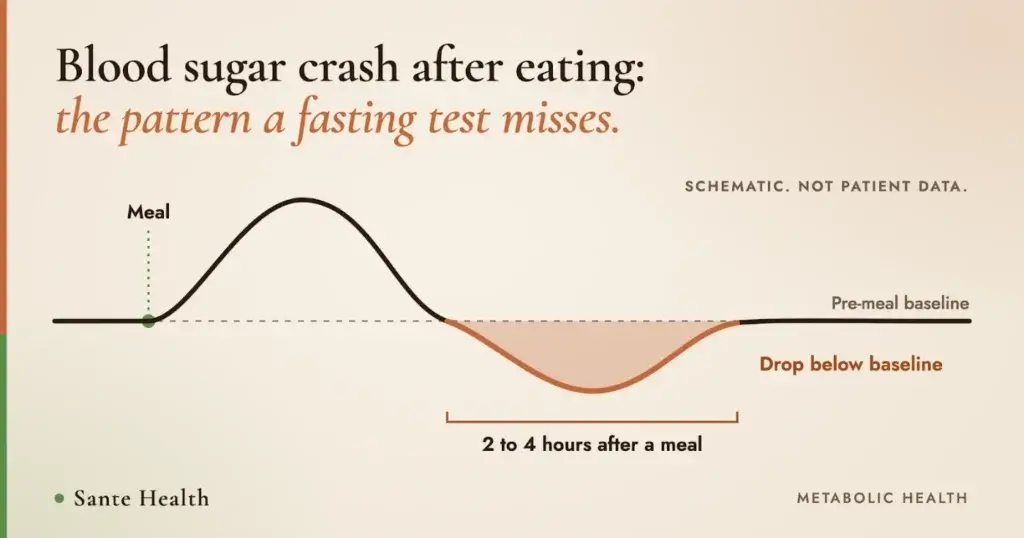
A blood sugar crash after eating is a fall in blood glucose, usually 2 to 4 hours after a meal, that brings shakiness, sudden hunger, fatigue, or trouble concentrating. A fasting glucose test is drawn before you’ve eaten, so it can’t record the drop. Fourteen days of continuous glucose monitor (CGM) data can, meal by meal.
What Does a Blood Sugar Crash After Eating Feel Like?
A post-meal crash feels like being weak and shaky after eating, with sweating, a racing heart, irritability, strong hunger, fatigue, or foggy concentration, usually 2 to 4 hours after the meal. The National Institute of Diabetes and Digestive and Kidney Diseases (NIDDK) lists the same set of symptoms for low blood glucose, and they ease once you eat.
The usual sequence starts with a meal that is mostly fast-digesting carbohydrate: a pastry with a sweetened coffee, a large bowl of white pasta, juice on an empty stomach. Glucose climbs quickly and the pancreas releases insulin to clear it. In some people the insulin response runs larger or later than the meal needs, and glucose falls below where it started.
That dip can change how you eat for the rest of the day. In a 2021 study in Nature Metabolism, Wyatt and colleagues tracked about 1,000 adults on CGMs after standardized breakfasts. The people whose glucose dipped furthest below baseline 2 to 3 hours later reported more hunger, ate sooner, and took in about 312 more calories over the day than people with small dips.
Is a Blood Sugar Crash the Same as Reactive Hypoglycemia?
Reactive hypoglycemia, also called postprandial hypoglycemia, is the clinical term for blood glucose that falls to a low level within 4 hours after eating. Clinicians use it for a specific, documented pattern. Many post-meal crashes are a smaller dip that stays inside the normal glucose range.
The Endocrine Society’s 2009 clinical practice guideline sets three conditions, known as Whipple’s triad, before low blood sugar is evaluated in adults without diabetes:
- Symptoms consistent with low blood glucose.
- A low glucose value measured at the time of those symptoms.
- Symptoms that resolve once glucose is brought back up.
Feeling shaky after lunch meets the first condition only. The other two require a measurement taken during symptoms, which is why a recurring post-meal crash is a pattern to evaluate with a clinician before it gets a name. Severe or recurring symptoms warrant prompt medical evaluation.
Why Can’t a Fasting Glucose Test See the Crash?
A fasting glucose test measures one moment after 8 or more hours without food, and the crash happens hours after a meal. A normal fasting result, below 100 mg/dL by American Diabetes Association (ADA) criteria, tells you your baseline is in range. It records nothing about the afternoon.
| Test | What it measures | What it shows about a post-meal crash |
|---|---|---|
| Fasting glucose | One value after an overnight fast | Nothing directly, because it’s drawn before any meal |
| HbA1c | Average glucose over about 2 to 3 months | Peaks and dips average out, so a crash pattern can sit inside a normal result |
| Fasting insulin | How much insulin it takes to hold fasting glucose steady | Context: a high value fits the outsized insulin response that can drive a dip |
| 14-day CGM | A reading every few minutes for two weeks | The rise, the fall, the timing, and whether the same meal repeats it |
Fasting insulin and HOMA-IR show how hard your body is working to keep glucose in range, and they’re read beside the CGM trace when a crash is being evaluated. Both are explained in the tests that detect insulin resistance.
What Does 14 Days of CGM Data Show About a Post-Meal Crash?
Fourteen days of CGM data show whether your glucose actually falls after the meals that come before a crash, how far below your pre-meal level it goes, and whether the same meal does it every time. Paired with a short symptom log, the trace either ties the crash to glucose or rules glucose out.
For a crash, the review reads five things:
- Peak and speed. How high glucose climbs after the meal, and how fast.
- The drop below baseline. Whether glucose falls under its pre-meal level 2 to 4 hours later, and by how much.
- Timing against symptoms. Whether a logged shaky or tired spell lines up with the dip on the trace.
- Repeatability. Whether the same breakfast produces the same curve on different days.
- Upstream factors. Short sleep, coffee on an empty stomach, alcohol, and hard training days, each read against the meals that follow them.
A flat trace on crash days is a result too. It moves the search to sleep, caffeine, hydration, or the hormone and nutrient markers on a lab panel.
Three limits matter most when the question is a low. The sensor reads the fluid under the skin, which trails blood glucose by roughly 5 to 15 minutes. CGMs are least accurate in the low range, so a single low reading is a prompt for a closer look, not a conclusion. And lying on the sensor overnight can press on the tissue and produce a false low, called a compression low. For how the device works outside a crash, see what 14 days of CGM data shows.
At Sante Health, the sensor is placed in person at the Westlake Village office, worn at home for 14 days, and reviewed with you in a 60-minute telehealth visit.
How Do You Stop a Blood Sugar Crash After Eating?
You stop a blood sugar crash after eating by making the glucose rise smaller: pair carbohydrate with protein, fat, and fiber, eat the carbohydrate last, space meals about 3 hours apart, and walk after you eat. A smaller rise usually means a smaller fall. The levers below come from NIDDK guidance and published glucose studies. A CGM shows which of them moves your own curve.
- Pair carbohydrate with protein, fat, and fiber. NIDDK guidance for post-meal lows is to build meals around protein and high-fiber foods and to limit high-sugar foods, especially on an empty stomach.
- Eat the carbohydrate last. In a 2015 study in Diabetes Care, Shukla and colleagues found that eating vegetables and protein before carbohydrate lowered glucose at the 1-hour mark by about 37% compared with the same meal eaten carbohydrate first. The study was small and its participants had type 2 diabetes, so your own trace is how you check the effect.
- Space meals about 3 hours apart. NIDDK suggests smaller meals and snacks spread through the day for people with post-meal lows.
- Move juice and sweetened coffee off an empty stomach. Liquid sugar with no food alongside it reaches the bloodstream fastest.
- Walk after you eat. A 2022 meta-analysis in Sports Medicine by Buffey and colleagues found that light walking in 2 to 5 minute bouts lowered post-meal glucose compared with sitting.
- Eat when you drink alcohol. Alcohol on an empty stomach can lower blood glucose, and NIDDK advises having food with it.
When Should You Book an Assessment for Post-Meal Crashes?
Book an assessment when post-meal crashes happen most weeks, when meal changes haven’t shifted them, or when they come with other metabolic signs such as a widening waist, rising fasting glucose, or weight that won’t move. The assessment looks for the metabolic pattern behind the crash and builds a plan around it.
The Comprehensive Metabolic Assessment reads metabolic panels, inflammatory markers, hormone levels, and nutrient status, then reviews them with you in a 90-minute telehealth consultation. Adding the CGM program puts your post-meal curve beside those labs. Both are part of metabolic care at Sante Health.
Fainting, confusion, or a seizure needs emergency care. These signs call for prompt evaluation with your primary care clinician before any assessment:
- symptoms come on when you haven’t eaten, or overnight
- you’ve had weight loss surgery
- you take insulin or another glucose-lowering medication
- crashes are becoming more frequent or more severe
Frequently Asked Questions
What is a normal blood sugar level after eating?
In people without diabetes, glucose usually peaks within an hour of a meal and returns toward its pre-meal level within 2 to 3 hours. The ADA’s normal cutoff 2 hours into a glucose tolerance test is below 140 mg/dL. No validated target exists for everyday meals.
Can you have a blood sugar crash without diabetes?
Yes. Post-meal dips happen in people without diabetes, and many stay within the normal glucose range. A drop to a measured low, with symptoms that resolve once glucose rises, is what clinicians evaluate as reactive hypoglycemia, one cause of low blood sugar without diabetes.
Is reactive hypoglycemia dangerous?
Reactive hypoglycemia symptoms usually ease once you eat, and on their own they’re rarely an emergency. A pattern that keeps coming back is worth evaluating with a clinician. Fainting, confusion, or a seizure needs emergency care.
Why do I feel tired after eating carbs?
A large serving of fast-digesting carbohydrate can produce a sharp rise and then a fall 2 to 4 hours later, and the fall can bring fatigue and hunger. Sleep, meal size, and alcohol also play a part, which is why the pattern is checked against your own data.
Can a CGM confirm reactive hypoglycemia?
No. A CGM shows the pattern and timing of post-meal drops, and it’s least accurate at low values. Confirming hypoglycemia takes a measured low blood glucose during symptoms, evaluated by a clinician.
Do I have to come in person for the CGM program?
Only for the sensor. It’s placed in person at Sante Health’s Westlake Village office. The 14 days of wear happen at home, and the 60-minute data review is by telehealth across California.
How much does a metabolic assessment cost?
Pricing varies by panel, and the panel is selected around your history and goals. Sante Health is a cash-pay practice, and superbills may be provided for select visit types.
How to Get Your Post-Meal Glucose Read at Sante Health
Sante Health reads post-meal glucose with the CGM program and the Comprehensive Metabolic Assessment, delivered by telehealth across California. The sensor is placed at Sante Health’s Westlake Village office, in the Conejo Valley, and every review after that happens from home.
Or call 805-370-0000.
About the author. Lovelle Valencia, NP, FNP, PMHNP is a board-certified Nurse Practitioner with specialized training in functional medicine (IFM), metabolic health (A4M), and psychiatric mental health. Professional affiliations: AANP, ANCC, A4M, IFM.
This article is for informational purposes only and does not constitute medical advice, diagnosis, or treatment. Consult a qualified healthcare provider for personalized guidance.