A continuous glucose monitor (CGM) is a small sensor worn on the arm that reads glucose in the fluid just under the skin every few minutes. Worn for 14 days by someone without diabetes, it shows how specific meals, workouts, stress, and short nights move your own blood sugar. It does not itself cause weight loss.
Is a CGM Worth It for Weight Loss?
It is worth it as a measurement tool, not as a weight loss intervention. Those are two different claims, and the distinction is the whole answer.
A sensor does not change body composition. What it can do is replace guesswork with your own data during a period when you are actually trying to change something. Wearing one while making no changes produces an interesting chart and nothing else.
The evidence is mixed. In a Weizmann Institute trial published in Diabetes Care, a CGM-guided personalized diet lowered blood sugar more than a Mediterranean diet, but it did not produce more weight loss. That finding is worth knowing before you spend money on a sensor, and it is consistent with what a CGM actually is: an instrument, not a treatment.
Access has widened considerably. In 2024 the FDA cleared the first over-the-counter continuous glucose monitors for adults not using insulin, which is why sensors that once required a diabetes prescription now sit next to the vitamins. Wider access has not changed what the device measures.
What Does a CGM Show Someone Without Diabetes?
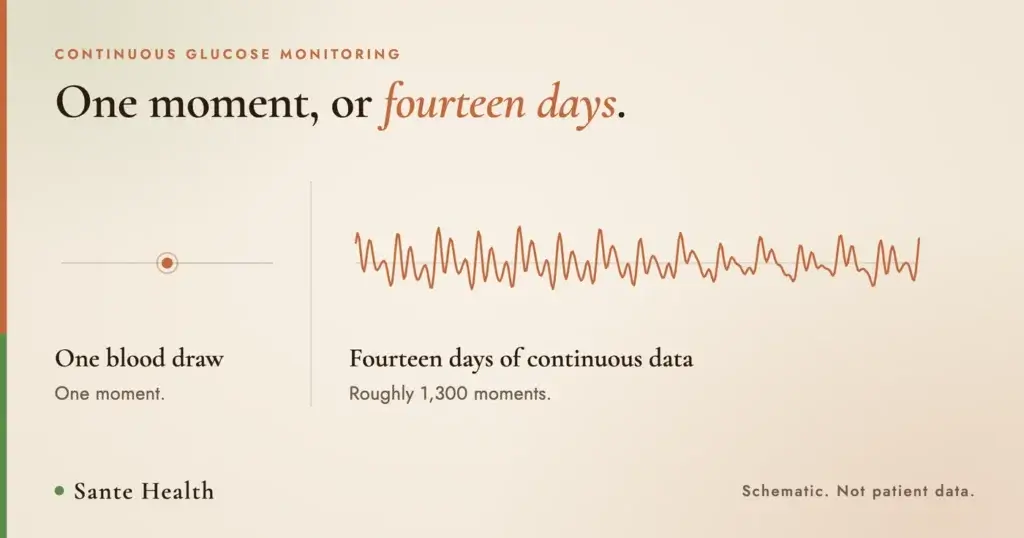
Four things a fasting blood draw cannot show, because a blood draw is one moment and a CGM is well over a thousand readings across two weeks.
Your response to specific meals. This is the finding that surprises people most, and it has good research behind it. Zeevi and colleagues, publishing in Cell in 2015, continuously monitored around 800 adults and found that post-meal glucose responses to the same standardized meals varied substantially from person to person. The bread that spikes your colleague may not spike you, and the opposite is equally true. General glycemic-index advice is a population average applied to an individual.
The size and shape of post-meal excursions. Not just how high glucose goes, but how fast it climbs and how hard it falls afterward. A steep rise followed by an overshoot in the other direction is the mechanism behind the familiar mid-afternoon crash, and it is visible on a trace in a way it never is on a lab report.
The effect of everything that is not food. A short walk after eating, a resistance session, a poor night’s sleep, a stressful morning. These all move glucose, and 14 days is long enough to see which of them moves yours most.
Your overnight and fasting baseline, repeatedly. A single fasting glucose is one sample. Fourteen mornings of fasting values, plus the overnight pattern between them, is a considerably more honest picture of where your baseline sits.
What 14 Days of CGM Data Actually Reveals
Patterns, not diagnoses. These are the ones that most often change a plan.
| Pattern on the trace | What it usually points to | What tends to follow |
|---|---|---|
| Large, sharp post-meal peaks with a fast drop after | Meals that are carbohydrate-forward and light on protein, fat, or fiber | Meal composition and sequencing before any change to total intake |
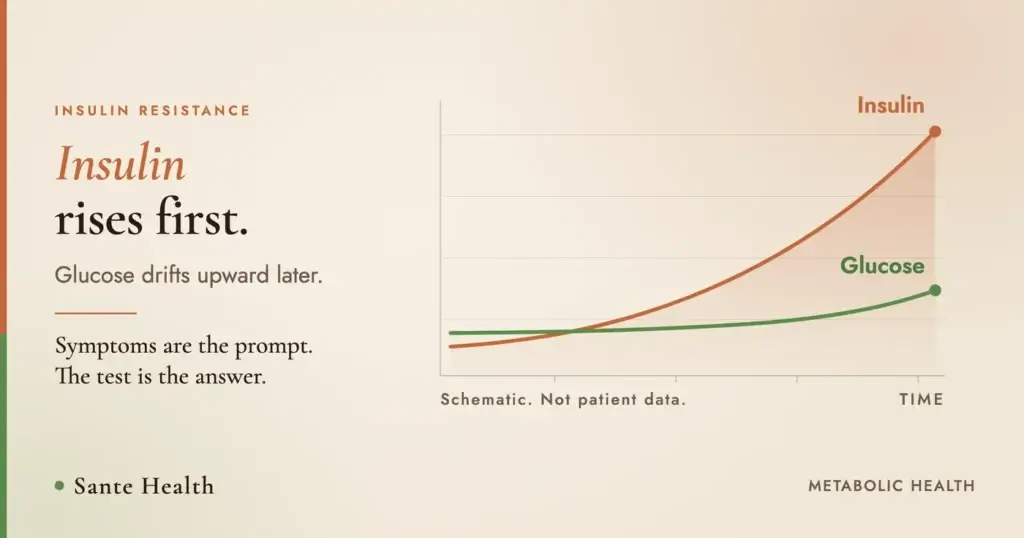
| A slow return to baseline after eating | Reduced glucose disposal, often a signal worth pairing with a fasting insulin result | Adding a lab, not adding a rule |
| A mid-afternoon dip matching the reported energy crash | The crash is a fuel-delivery pattern rather than a discipline problem | Restructuring lunch instead of adding caffeine |
| Rising overnight values after short sleep | The sleep and glucose relationship, visible in your own data | Sleep first, because it sits upstream of the rest |
| A flat, unremarkable two weeks | Glucose regulation is not where the problem lives | Looking elsewhere, which is a useful result in itself |
That last row matters more than it looks. A CGM that finds nothing has ruled out a whole category of explanation and redirected the search, which is worth the two weeks on its own.
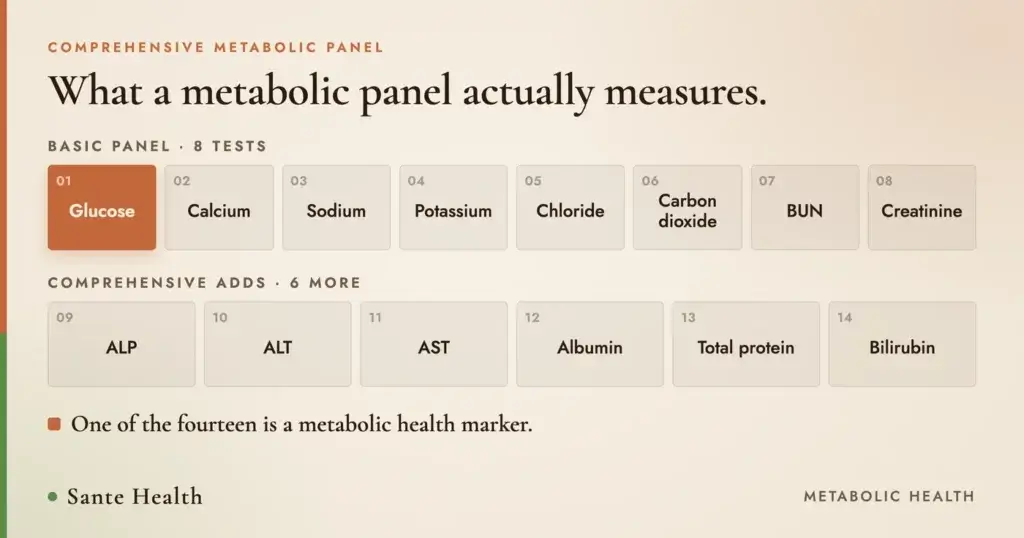
Reading a trace alongside bloodwork is where it becomes actionable. Glucose variability tells you what is happening; fasting insulin and the rest of the panel tell you how hard your body is working to produce it. That combination is covered in the tests that detect insulin resistance and in what a single fasting panel leaves out.
What a CGM Cannot Tell You
Four limits, and they apply to consumer sensors and clinical ones alike.
- It is not measuring blood. The sensor reads interstitial fluid, which lags blood glucose by roughly 5 to 15 minutes. During a fast rise or fall, the number on your phone is describing where you were, not where you are.
- There is no validated target range for adults without diabetes. The 2019 international consensus on time in range set 70 to 180 mg/dL as the target for people with diabetes. No equivalent evidence-based target has been established for people without it, so anyone selling you a strict non-diabetic range is extrapolating.
- It is not a diagnostic or screening test. Diabetes and prediabetes are identified using defined fasting glucose, HbA1c, and glucose tolerance criteria. A CGM adds context to those results. It does not replace them, and a clinician still makes the call.
- A single reading is not reliable on its own. These devices are built for trends. Judging one meal by one number, or comparing a sensor value directly against a fingerstick, will mislead you.
How the CGM Program Works at Sante Health
The device is only useful if someone reads it with you. The CGM program at Sante Health is built around that step.
- Get the device. It can be mailed to your home with step-by-step instructions, or inserted in-office at our Westlake Village location.
- Wear it for 14 days. Normal life, normal food. A two-week window is long enough to capture weekday and weekend patterns and at least one bad night’s sleep.
- Review the data in a 60-minute telehealth interpretation visit. The full trace is read against your history, your symptoms, and your labs.
You leave with specific adjustments grounded in your own physiology rather than a generic protocol. For patients already working on body composition, the same data informs medically supervised weight management by showing which changes are actually moving your numbers.
Frequently Asked Questions
Do I need diabetes to wear a CGM?
No. Since 2024 the FDA has cleared over-the-counter continuous glucose monitors for adults who do not use insulin, and clinicians have used them for metabolic assessment for longer than that. Sante Health’s program is designed for people without a diabetes diagnosis.
Does wearing a CGM make you lose weight?
No. The sensor measures, it does not treat. Any change comes from what you do with the data, and published research is mixed on whether CGM-guided eating produces more weight loss than a standard approach.
Why 14 days rather than a few days or several months?
Fourteen days covers weekday and weekend eating, at least one disrupted night, and enough repeat meals to separate a pattern from a one-off. Shorter windows produce noise. Longer ones rarely add new information for a first assessment.
Does inserting the sensor hurt?
Most people describe the applicator as a brief pinch rather than pain. The sensor sits on the back of the upper arm and is worn continuously, including through showers and sleep. Some people get mild adhesive irritation.
Is a CGM covered by insurance if I am not diabetic?
Generally no. Coverage for continuous glucose monitoring is usually limited to specific diabetes criteria, so a metabolic-assessment CGM is typically an out-of-pocket program. Sante Health is a cash-pay practice and can provide a superbill for select visit types.
Should I get a CGM or a lab panel first?
For most people, labs first. A panel that includes fasting insulin establishes the baseline; a CGM then shows the day-to-day behavior around it. Running both makes each more interpretable, which is why they are often ordered together.
How to Start a 14-Day CGM Program
If your labs keep reading normal and you want to see what your own glucose is actually doing, 14 days of data is the fastest way to find out. Sante Health delivers metabolic care by telehealth across California, with the sensor mailed or placed at our Westlake Village office and the interpretation done with the clinician who ordered it.
Or call 805-370-0000.
About the author. Lovelle Valencia, NP, FNP, PMHNP is a board-certified Nurse Practitioner with specialized training in functional medicine (IFM), metabolic health (A4M), and psychiatric mental health. Professional affiliations: AANP, ANCC, A4M, IFM.
This article is for informational purposes only and does not constitute medical advice, diagnosis, or treatment. Consult a qualified healthcare provider for personalized guidance.