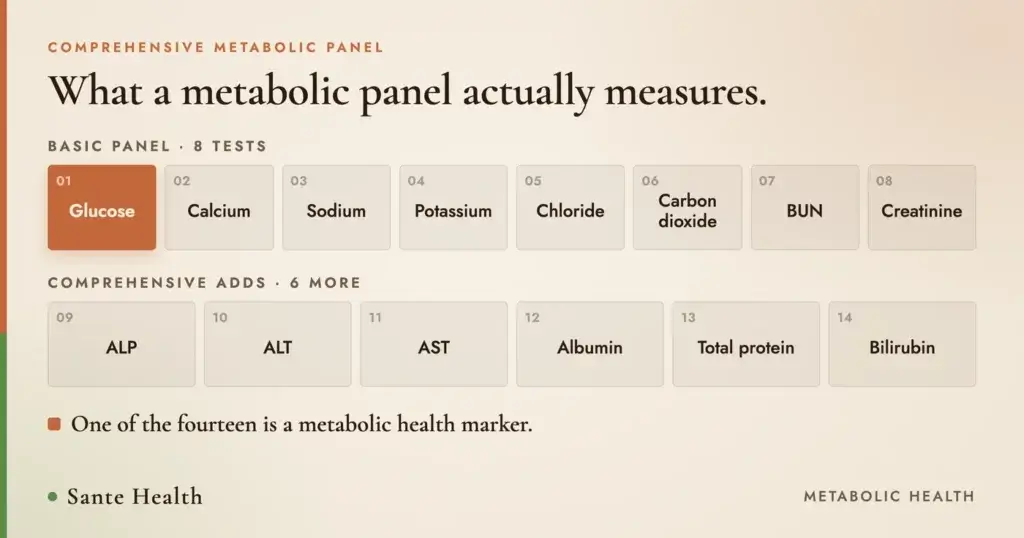
Insulin resistance is a state in which cells respond less readily to insulin, so the pancreas produces more of it to keep blood sugar in range. Its defining feature is that it usually produces no clear symptoms early. That is why insulin resistance symptoms are a poor screening tool, and testing is the reliable one.
How Do You Know If You Are Insulin Resistant?
You find out by measuring, not by how you feel. The Cleveland Clinic and the National Institute of Diabetes and Digestive and Kidney Diseases both describe insulin resistance as typically asymptomatic in its early stages, because the extra insulin the pancreas produces is doing exactly what it is supposed to do: holding glucose inside its normal range.
That is the whole difficulty. The compensation works, so nothing feels wrong and nothing on a routine report looks wrong. The symptoms most people associate with insulin resistance tend to appear later, or they appear early and get attributed to workload, age, or poor sleep.
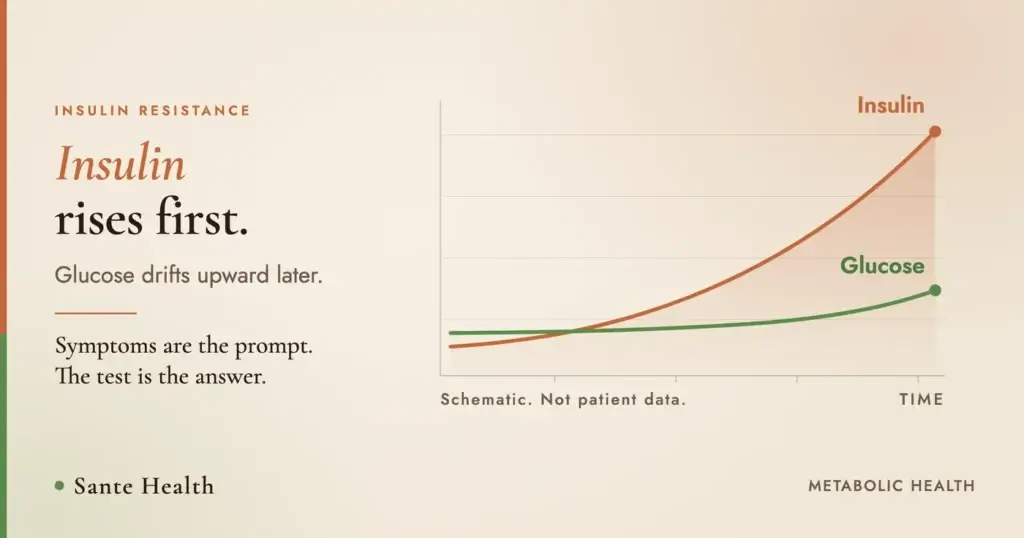
So the useful sequence runs the other way around from what most people expect. Symptoms are the prompt to test. The test is the answer.
What Are the Signs of Insulin Resistance?
The signs fall into two groups, and they carry very different weight.
Functional signs are common, non-specific, and easy to explain away:
- A pronounced energy drop or sleepiness within a couple of hours of a carbohydrate-heavy meal
- Strong cravings for sugar or fast carbohydrates, and hunger returning soon after eating
- Weight that has become resistant to the nutrition and training that used to work
- Fat accumulating around the middle without a large change in overall body weight
- Brain fog, slower recall, or difficulty holding concentration through the afternoon
- Sleep that runs the right number of hours without leaving you restored
Any of these can have a dozen other causes. Several of them together, in someone whose annual labs keep reading normal, is the pattern that justifies a proper look. The broader version of that pattern is covered in the five markers that define metabolic health.
Physical signs a clinician looks for
These carry more weight because they are specific and observable:
- Acanthosis nigricans. Darkened, thickened, velvety skin at the back of the neck, the armpits, or the groin. It is a recognized skin marker of high circulating insulin.
- Skin tags. Small soft skin growths, most often at the neck and underarms, frequently found alongside acanthosis nigricans.
- Central adiposity. The harmonized 2009 metabolic syndrome criteria use a waist circumference above 40 inches in men and above 35 inches in women as the threshold for most populations in the United States.
- Cycle irregularity or polycystic ovary syndrome. Insulin resistance is a well-established feature of PCOS, so a PCOS history is a reason to test rather than a reason to wait.
None of these confirm anything on their own. They change the pre-test probability enough that measuring becomes the obvious next step.
Which Tests Actually Detect Insulin Resistance?
There is no single definitive test used in routine practice. What exists is a set of measures that each catch a different part of the picture, and the choice depends on how early you want to catch it.
| Test | What it measures | What it catches |
|---|---|---|
| Fasting insulin | How much insulin is required at rest to hold glucose steady | The earliest signal. Rises well before glucose does, and is not on a standard panel |
| HOMA-IR | Fasting insulin and fasting glucose read as a single index | Insulin resistance while both individual values still read normal |
| Fasting glucose | Blood sugar after an overnight fast | A later stage, once compensation has started to fail |
| HbA1c | Average blood sugar over roughly three months | Sustained elevation. The American Diabetes Association reads below 5.7 percent as normal, 5.7 to 6.4 percent as prediabetes, and 6.5 percent or higher as diabetes |
| Triglyceride-to-HDL ratio | A lipid pattern that tracks with insulin resistance | A useful surrogate calculated from a lipid panel you may already have |
| Oral glucose tolerance test with insulin | Glucose and insulin at intervals after a measured glucose load | The dynamic response, including a high insulin spike in someone whose fasting numbers are fine |
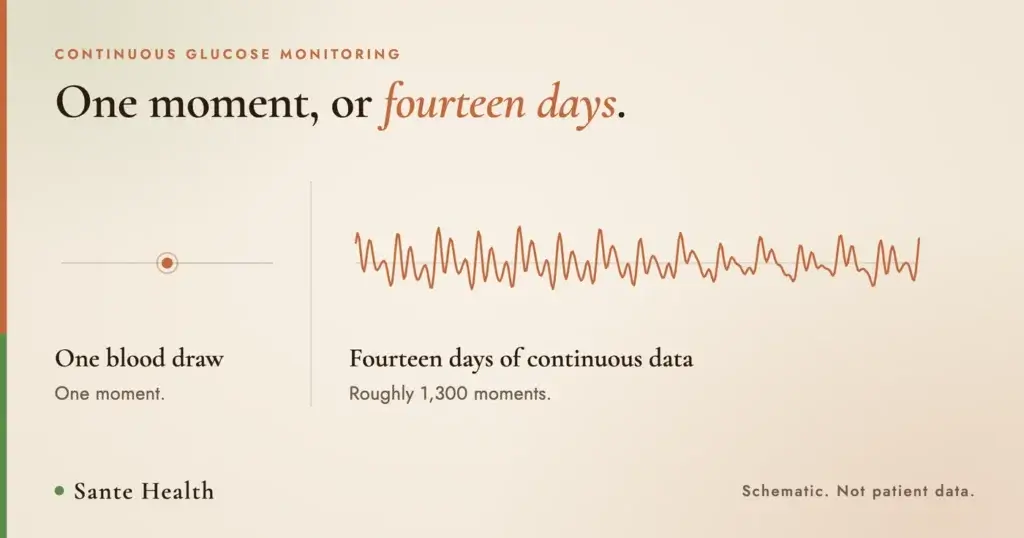
| Continuous glucose monitor | Glucose every few minutes for 14 days | Day-to-day variability and post-meal spikes no single blood draw can show |
| Waist-to-height ratio | Waist measurement divided by height | Central adiposity, at no cost. The UK’s National Institute for Health and Care Excellence advises keeping this below 0.5 |
The two tests that do the most work
Fasting insulin, paired with fasting glucose. This is the practical starting point, because it measures the effort rather than the result. Insulin is not included on a comprehensive metabolic panel, so it has to be ordered deliberately. It also means little in isolation, since standard reference ranges are drawn from a population in which insulin resistance is common. Pairing it with glucose as HOMA-IR is what makes it interpretable, and the arithmetic and thresholds are covered in how fasting insulin and HOMA-IR are read together.
The triglyceride-to-HDL ratio. McLaughlin and colleagues, writing in Annals of Internal Medicine in 2003, proposed a fasting triglyceride-to-HDL ratio of 3.0 or higher as a simple marker for identifying insulin-resistant adults. Its accuracy varies across populations, so it is a screening signal rather than a verdict. Its advantage is that most people already have the two numbers on a lipid panel sitting in a patient portal.
What a home test can and cannot tell you
Direct-to-consumer kits will measure HbA1c and, increasingly, fasting insulin from a finger stick. They are real measurements. What they do not provide is the part that changes anything: a clinician who ordered the right combination for your history, who reads the values against each other and against your own prior results, and who can act on what they find. A number without an interpretation tends to generate anxiety rather than a plan.
Why a Normal Fasting Glucose Does Not Rule It Out
This is the single most common reason insulin resistance goes unnoticed for years.
Insulin rises first. Glucose only drifts upward once the pancreas can no longer keep pace. Someone can spend a long stretch producing progressively more insulin, with every fasting glucose in that stretch reported as normal, because normal is precisely what the extra insulin is buying. A panel that measures glucose but never measures insulin is watching the second event in the sequence and missing the first.
Direction of travel matters as much as any single value. A fasting glucose that has moved from 84 to 97 over six years is flagged normal on every individual report, and the movement is the finding.
Can Insulin Resistance Be Improved?
Insulin sensitivity responds to changed inputs, and the evidence behind that is unusually strong for a lifestyle question.
The Diabetes Prevention Program, published in the New England Journal of Medicine in 2002, randomized more than 3,000 adults with impaired glucose tolerance. It found that an intensive lifestyle intervention built around modest weight loss and 150 minutes of weekly activity reduced the incidence of type 2 diabetes by 58 percent over an average of 2.8 years, outperforming metformin in the same trial.
The levers with the most evidence behind them are unglamorous: sleep, protein and fiber at meals, resistance training to build the muscle that disposes of most of the body’s glucose, a short walk after eating, and less alcohol. Most markers show meaningful movement in three to six months. HbA1c lags by design, because it averages the preceding three.
What a clinician adds is sequence and measurement. Knowing which lever matters most for your specific pattern, and confirming the pattern actually moved, is the difference between a plan and a guess.
Frequently Asked Questions
How do I test for insulin resistance?
Ask for fasting insulin alongside fasting glucose, which together give HOMA-IR, plus HbA1c and a lipid panel. Fasting insulin is the key addition, because it is not included on standard bloodwork and has to be ordered on purpose.
What are the earliest signs of insulin resistance?
There often are none. When early signs do appear they are non-specific: an energy crash after carbohydrate-heavy meals, carb cravings, weight settling around the middle, and afternoon brain fog. Physical signs such as skin tags and darkened neck or underarm skin usually come later.
Can you be insulin resistant at a normal weight?
Yes. Waist circumference is one contributor among several, and body composition matters more than the number on a scale. Someone at a normal body weight can still show elevated fasting insulin, a high triglyceride-to-HDL ratio, and central fat distribution.
Is insulin resistance the same as prediabetes?
No. Insulin resistance describes how readily cells respond to insulin. Prediabetes is a diagnosis defined by specific glucose and HbA1c thresholds. Insulin resistance typically comes first and can be present for years while glucose values stay inside the normal range.
How long does it take to improve insulin sensitivity?
Most metabolic markers show measurable movement in three to six months of consistent change. Fasting insulin and triglycerides tend to respond earliest. HbA1c reflects a rolling three-month average, so it is best rechecked at three months at the soonest.
When should I see a clinician about this?
Book if the functional signs have persisted, if your labs keep reading normal while something still feels off, or if you have a family history of type 2 diabetes, a PCOS diagnosis, or a history of gestational diabetes. Those histories move testing up the list.
How to Get Tested
If the pattern sounds familiar and your annual bloodwork keeps coming back unremarkable, the useful next step is measuring the markers that were never ordered. A Comprehensive Metabolic Assessment at Sante Health covers fasting insulin, inflammatory markers, particle-level lipids, full thyroid, and nutrient status, and ends with a 90-minute telehealth visit spent on interpretation rather than data collection.
Sante Health delivers metabolic care by telehealth across California, with labs drawn locally and results reviewed with the clinician who ordered them.
or call 805-370-0000.
About the author. Lovelle Valencia, NP, FNP, PMHNP is a board-certified Nurse Practitioner with specialized training in functional medicine (IFM), metabolic health (A4M), and psychiatric mental health. Professional affiliations: AANP, ANCC, A4M, IFM.
This article is for informational purposes only and does not constitute medical advice, diagnosis, or treatment. Consult a qualified healthcare provider for personalized guidance.