A comprehensive metabolic assessment is a wider panel of labs, ordered together and read as a single pattern. It adds fasting insulin, inflammatory markers, particle-level lipids, full thyroid, and nutrient status to what routine bloodwork already covers. The interpretation is the deliverable, not the marker count.

What Is a Comprehensive Metabolic Assessment?
A comprehensive metabolic assessment is a broad laboratory evaluation of the systems that regulate energy, ordered and interpreted together rather than one result at a time. It covers metabolic, inflammatory, hormonal, and nutrient markers, and it ends with a clinician reading them as a single pattern.
The distinction that matters is not the number of tests. It is that the markers are chosen to answer a question about how your metabolism is functioning, then interpreted against each other and against your own prior results. A routine panel compares each value to a population reference range in isolation.
What Does a Standard Panel Actually Measure?
Most annual bloodwork is some combination of four tests:
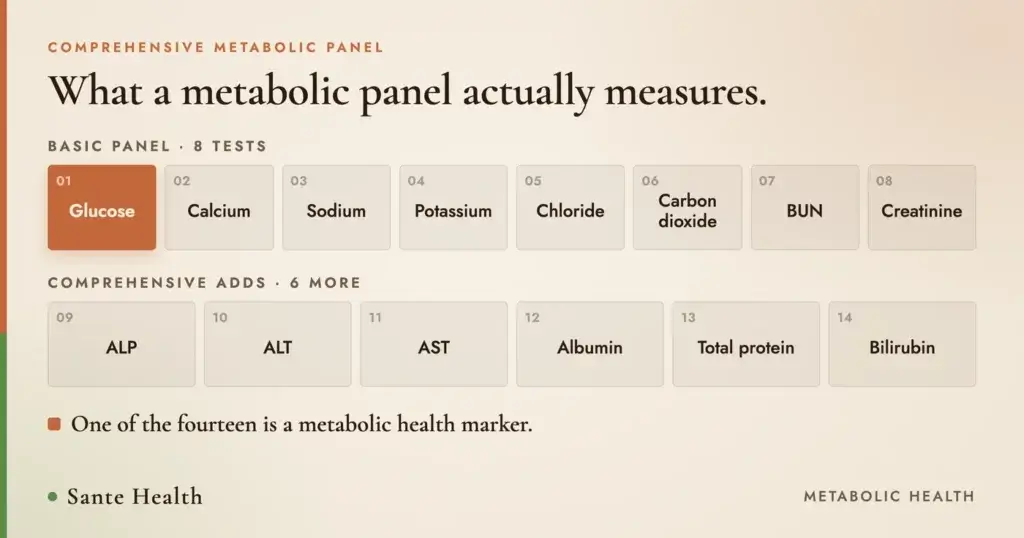
- Comprehensive metabolic panel (CMP). Fourteen markers covering glucose, electrolytes, kidney function, and liver enzymes.
- Complete blood count (CBC). Red cells, white cells, and platelets.
- Lipid panel. Total cholesterol, LDL-C, HDL-C, and triglycerides.
- TSH. A single thyroid screening value.
That set is well designed for what it was built to do: detect established disease. It will catch anemia, kidney impairment, liver injury, and diabetes. What it does not do is describe how hard your body is working to keep those results normal, and that is a different question with different markers attached to it.
What Do Standard Labs Miss?
Five categories of information are absent from the panel above. None of them are exotic tests.
| What routine bloodwork gives you | What is missing, and why it matters |
|---|---|
| Fasting glucose and HbA1c | Fasting insulin. Glucose is the outcome. Insulin is the effort required to produce it, and it moves first |
| LDL cholesterol, a measure of cholesterol mass | apoB. A count of atherogenic particles. There is one apoB molecule per particle, so apoB and LDL-C can disagree. The 2018 AHA/ACC cholesterol guideline treats apoB of 130 mg/dL or higher as a risk-enhancing factor |
| Nothing on inflammation | hs-CRP. The 2003 AHA/CDC statement categorized below 1 mg/L as lower cardiovascular risk, 1 to 3 mg/L as average, and above 3 mg/L as higher |
| TSH only | Free T3 and free T4. TSH shows the pituitary’s signal. These show how much active thyroid hormone is actually available |
| Nothing on nutrient status | Vitamin D, B12, ferritin, RBC magnesium. Cofactor availability for energy production, cognition, and mood |
A fuller picture of the underlying framework is in what metabolic health actually measures.
Fasting Insulin: A Worked Example
Fasting insulin is the clearest illustration of the gap, so it is worth walking through in detail.
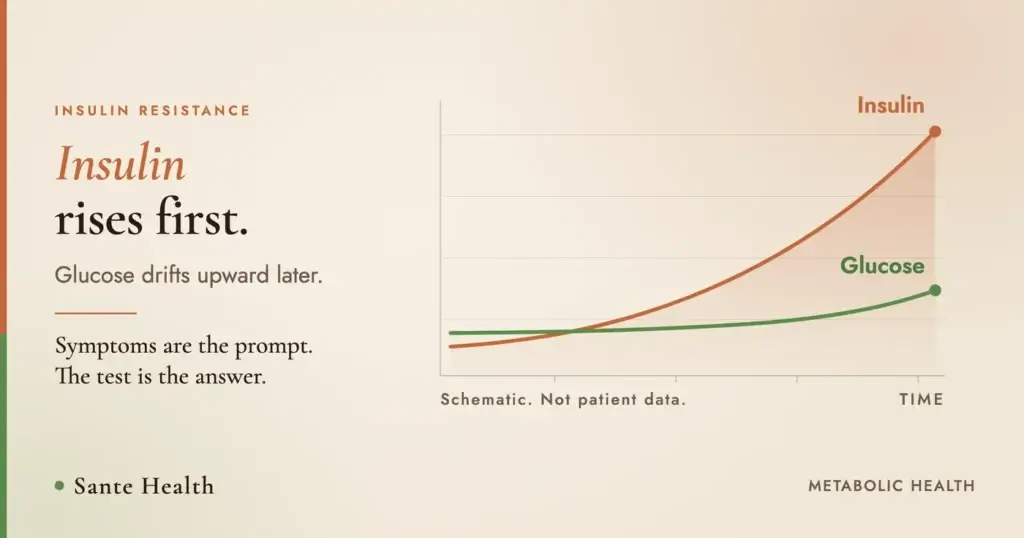
Insulin is the hormone that moves glucose out of the bloodstream and into cells. When cells respond to it less readily, the pancreas compensates by producing more. For a long stretch that compensation works: glucose stays inside its range, the annual panel reads normal, and the only thing that has changed is a number nobody measured.
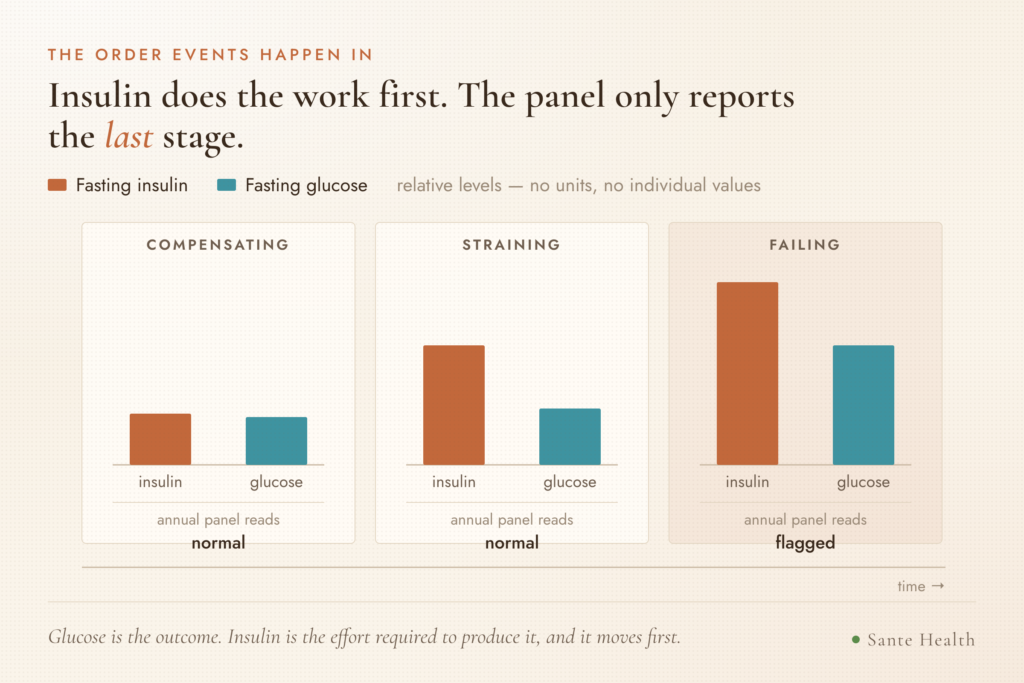
Fasting glucose only drifts upward once the compensation begins to fail. By then the underlying change has been in progress for a while.
Reading insulin on its own is not very useful, because standard reference ranges run as wide as roughly 2 to 25 µIU/mL, a span drawn from a population in which insulin resistance is common. Pairing it with glucose is what makes it informative. HOMA-IR, the homeostatic model assessment of insulin resistance, was described by Matthews and colleagues in Diabetologia in 1985:
HOMA-IR = (fasting insulin in µIU/mL × fasting glucose in mg/dL) ÷ 405
Cut points vary by population and no universal threshold exists, but values above roughly 2.0 to 2.5 are the ones most commonly used in the research literature to flag insulin resistance in adults.
How the Markers Are Read as a Pattern
Any one of these markers can be run, reported, and filed without changing anything. The value comes from reading them against each other.
Here is what that looks like in practice. Fasting glucose 96, HbA1c 5.5, both comfortably normal. Add fasting insulin at 16 µIU/mL and HOMA-IR lands near 3.8. Add triglycerides of 155 with HDL of 41 and the lipid ratio points the same way. Add hs-CRP at 3.4 and there is an inflammatory component running alongside it. No single result on that list would generate a phone call. Together they describe a specific physiology and suggest a specific order of operations for changing it.
Direction of travel carries as much weight as any current value. A HOMA-IR that has moved from 1.1 to 2.3 over four years is a different picture than one that has sat at 2.3 the whole time, even though today’s number is identical.
That interpretive step is the actual deliverable. Sante Health’s Comprehensive Metabolic Assessment pairs the panel with a 90-minute review led by the clinician who ordered it, and you can see how Sante Health approaches metabolic screening across the wider care model.
Frequently Asked Questions
What does a comprehensive metabolic assessment include?
A metabolic and cardiovascular foundation, inflammatory markers, a full thyroid panel, hormones, and nutrient status, plus a clinician’s interpretation of the pattern. The exact marker list is calibrated to your history rather than run as a fixed package.
Is a comprehensive metabolic panel the same as a comprehensive metabolic assessment?
No, and the similar names cause real confusion. A comprehensive metabolic panel (CMP) is a basic 14-marker chemistry test covering glucose, electrolytes, kidney, and liver. It contains no insulin, no inflammatory marker, and no thyroid test. The assessment is the wider evaluation built around it.
How is this different from an annual physical?
An annual physical typically runs a CMP, CBC, lipid panel, and TSH, then checks each result against a population reference range. The assessment adds insulin, inflammatory markers, particle-level lipids, full thyroid, and nutrient status, and reads them as one pattern across systems rather than as separate pass or fail flags.
Why isn’t fasting insulin on a standard panel?
Because routine screening guidelines are built to detect diabetes, and insulin is not part of the diagnostic criteria for type 2 diabetes. Insulin assays are also less standardized than glucose assays, and no guideline defines an insulin level that triggers a specific intervention.
Do I need to fast before these labs?
Yes, generally 8 to 12 hours with water only. Fasting glucose, fasting insulin, and the lipid panel all assume a fasted draw, and HOMA-IR requires glucose and insulin from the same sample. Morning appointments put the fasting window overnight.
How often should these markers be repeated?
Most show meaningful movement at 3 to 6 months, so that is the usual re-test interval. Testing sooner tends to capture normal biological variation rather than real change. HbA1c reflects a rolling three-month average, so a re-check before three months have passed will show very little.
How to Get a Comprehensive Metabolic Assessment
If routine bloodwork keeps reading normal while something clearly is not, the useful next step is a wider panel and someone to interpret it. Sante Health runs metabolic care by telehealth across California, with labs drawn at a site near you and results reviewed with the clinician who ordered them.
Book a Comprehensive Metabolic Assessment, or contact the Sante Health team to talk through whether it is the right next step.
Or call 805-370-0000.
About the author. Lovelle Valencia, NP, FNP, PMHNP is a board-certified Nurse Practitioner with specialized training in functional medicine (IFM), metabolic health (A4M), and psychiatric mental health. Professional affiliations: AANP, ANCC, A4M, IFM.
This article is for informational purposes only and does not constitute medical advice, diagnosis, or treatment. Consult a qualified healthcare provider for personalized guidance.