Key Takeaways
- What is metabolic health? Five measurable markers: fasting glucose, triglycerides, HDL cholesterol, blood pressure, and waist circumference. Body weight is not one of them.
- Three or more markers out of range meets the clinical definition of metabolic syndrome. Optimal metabolic health means all five are in range without medication.
- A result can sit inside a standard reference range and still be trending the wrong way, which is why the direction of travel matters as much as any single number.
- Fasting insulin, HbA1c, apoB, and hs-CRP add resolution the standard five do not, and most of them are not on a routine panel.
What Is Metabolic Health?
Metabolic health is how efficiently your body converts food into usable energy and keeps the resulting fuel supply stable. Clinically, it is measured by five specific markers, and it has nothing directly to do with what you weigh.
The five come from the harmonized criteria for metabolic syndrome published jointly in 2009 by the International Diabetes Federation, the American Heart Association, the National Heart, Lung, and Blood Institute, and several partner bodies:
| Marker | Out-of-range threshold |
| Fasting glucose | 100 mg/dL or higher |
| Triglycerides | 150 mg/dL or higher |
| HDL cholesterol | Below 40 mg/dL (men), below 50 mg/dL (women) |
| Blood pressure | 130/85 mmHg or higher |
| Waist circumference | 40 inches or more (men), 35 inches or more (women) |
Three or more of these out of range meets the definition of metabolic syndrome. Optimal metabolic health is the stricter standard: all five in range, without medication holding them there. One widely cited analysis of National Health and Nutrition Examination Survey data from 2009 to 2016, published in Metabolic Syndrome and Related Disorders, put the share of American adults meeting that stricter bar at roughly 12 percent.
That figure is why the topic keeps surfacing. Most adults are not in the diagnosed-disease category and are not in the optimal category either. They are somewhere in the middle, where nothing has a name yet.
Can You Be “Normal” on Labs and Still Have Poor Metabolic Health?
Yes, and it is common. A standard lab reference range describes where most results in a reference population fall. It does not describe where a result is healthiest.

Fasting glucose is the clearest example. The American Diabetes Association puts the normal cutoff at 100 mg/dL, prediabetes at 100 to 125 mg/dL, and diabetes at 126 mg/dL or above. Someone whose fasting glucose has moved from 84 to 97 over six years is flagged “normal” on every one of those reports. The direction of travel is the finding, and no single report shows it.
The same logic runs across the panel. Triglycerides climbing from 70 to 140, HDL sliding from 62 to 44, blood pressure creeping from 112/70 to 128/82: each result reads as unremarkable on its own, and the pattern across them does not.
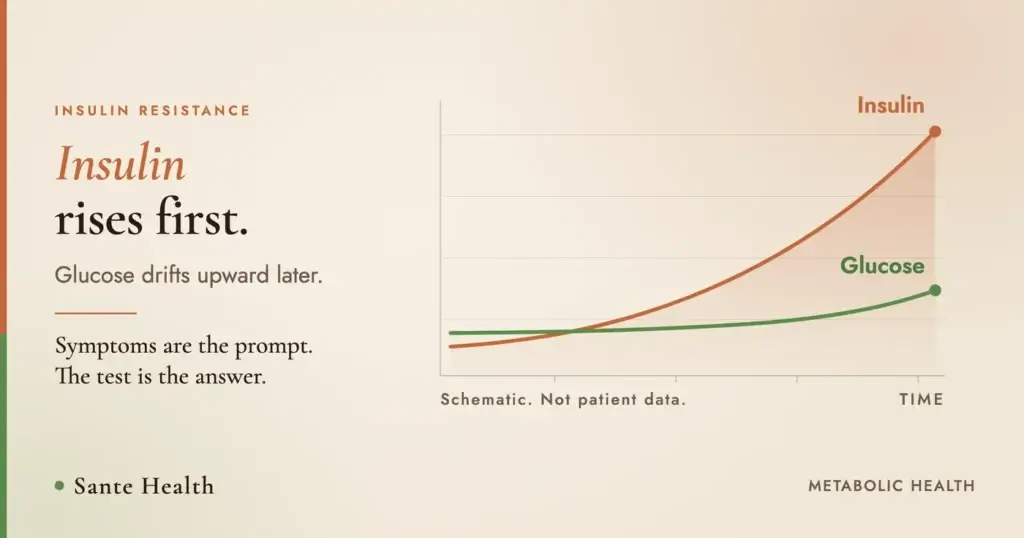
In practice, the marker that shifts earliest is usually not on the standard five at all. Insulin rises first to keep glucose inside its range, and glucose only drifts upward once that compensation starts to fail. A panel that measures glucose but never measures insulin is watching the second event and missing the first.
What Are the Signs of Poor Metabolic Health?
Metabolic change is quiet before it is loud. The symptoms people report tend to be non-specific enough that they get attributed to age, stress, or workload:
- A predictable mid-afternoon energy drop you have started scheduling around
- Weight that resists the same nutrition and training that used to work
- Brain fog or slower recall that was not there a few years ago
- Sleep that runs the right number of hours without leaving you restored
- Strong hunger or irritability roughly two to three hours after eating
- A rising waist measurement without a large change in overall body weight
- Skin tags, or darkened velvety skin at the neck, armpits, or groin, which can accompany insulin resistance
- Blood pressure or triglycerides that have each moved a little at every annual visit
None of these confirm anything alone. Several of them together, in someone whose labs keep reading normal, is the pattern worth measuring properly.
Which Markers Add Resolution Beyond the Standard Five?
The five criteria markers were designed to identify established metabolic syndrome. They were not designed to catch early change. Four additional markers do more of that work, and only one is routinely included on a basic panel.
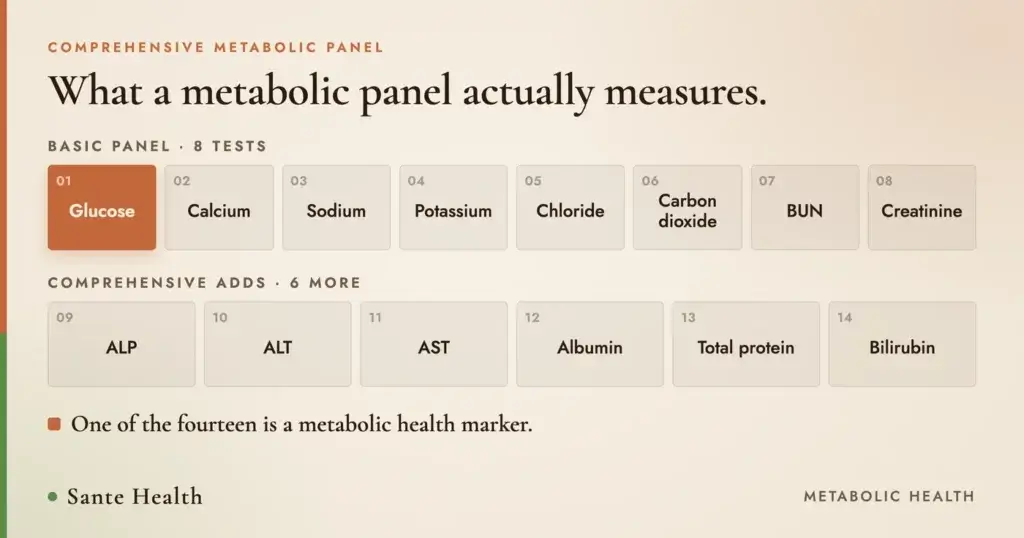
- Fasting insulin. Measures the effort required to hold glucose steady. It typically rises well before fasting glucose does, and it is not part of a comprehensive metabolic panel.
- HbA1c. Reflects average blood sugar over roughly three months. The American Diabetes Association reads below 5.7 percent as normal, 5.7 to 6.4 percent as prediabetes, and 6.5 percent or higher as diabetes.
- ApoB. Counts atherogenic lipoprotein particles rather than measuring cholesterol mass. Because there is one apoB molecule per particle, apoB and LDL cholesterol can disagree, and the 2018 American Heart Association and American College of Cardiology cholesterol guideline treats an apoB of 130 mg/dL or higher as a risk-enhancing factor.
- hs-CRP. A general marker of low-grade inflammation. The joint 2003 American Heart Association and Centers for Disease Control statement categorized values below 1 mg/L as lower cardiovascular risk, 1 to 3 mg/L as average, and above 3 mg/L as higher.
Read together, these turn a set of pass/fail flags into a picture with direction and cause. That interpretation step is the point of metabolic screening that goes past a standard panel, and it is the difference between knowing a number and knowing what to do about it.
How Do You Improve Metabolic Health?
Metabolic markers respond to inputs, and most respond faster than people expect. The levers with the strongest evidence behind them are unglamorous:
- Protect sleep first. Experimental sleep restriction measurably reduces insulin sensitivity in healthy adults within days. Sleep is usually the cheapest marker to move and the one most often skipped.
- Build meals around protein and fiber. Both blunt the glucose rise after eating, which lowers the amount of insulin required to clear it.
- Add resistance training. Skeletal muscle is the body’s largest site of glucose disposal, and increasing it increases where glucose can go.
- Walk after meals. Ten to fifteen minutes of easy movement after eating lowers the post-meal glucose peak without any change to the meal itself.
- Audit alcohol. Alcohol raises triglycerides and degrades sleep quality, which puts it upstream of two different markers at once.
- Re-measure on a real interval. Most metabolic markers show meaningful movement at 3 to 6 months. Testing sooner tends to produce noise rather than signal.
At Sante Health, this sequence sits inside the ADORE framework, which moves through five distinct stages, assess, decode, optimize, refine, and empower, rather than handing a patient a lab report and a supplement list.
Frequently Asked Questions
What are the five markers of metabolic health?
Fasting glucose, triglycerides, HDL cholesterol, blood pressure, and waist circumference. Three or more out of range meets the clinical definition of metabolic syndrome, and optimal metabolic health means all five sit in range without medication maintaining them.
How do I test whether I am metabolically healthy?
The five criteria markers come from a basic lipid panel, a fasting glucose, a blood pressure reading, and a tape measure. Adding fasting insulin, HbA1c, apoB, and hs-CRP gives you the early signal plus the inflammatory and particle context the basic five leave out.
Can you be thin and metabolically unhealthy?
Yes. Waist circumference is only one of the five criteria, so someone at a normal body weight can still have elevated triglycerides, low HDL, elevated fasting glucose, and elevated blood pressure. Body weight and metabolic health are related but not interchangeable.
Is metabolic syndrome the same as diabetes?
No. Metabolic syndrome is a cluster of risk markers, and elevated fasting glucose is only one of the five. Someone can meet the criteria for metabolic syndrome with a fasting glucose well below the diabetes threshold, which is part of why it works as an early risk signal.
How long does it take to improve metabolic markers?
Most markers show measurable movement in 3 to 6 months of consistent change. Triglycerides and fasting insulin tend to respond earliest. HbA1c reflects a rolling three-month average, so it lags by design and is best re-checked at 3 months at the soonest.
What is the difference between this and my annual physical?
An annual physical typically runs a comprehensive metabolic panel, a complete blood count, a lipid panel, and a TSH, then compares each result to a population reference range. A Comprehensive Metabolic Assessment adds insulin, inflammatory markers, particle-level lipids, full thyroid, and nutrient status, and reads them as one pattern across systems.
How to Get Your Metabolic Health Measured
If your labs keep coming back normal and something still feels off, the useful next step is measurement rather than another round of guessing. Sante Health delivers metabolic care by telehealth across California, with labs drawn locally and results reviewed with the clinician who ordered them.
Book a Comprehensive Metabolic Assessment, or contact the Sante Health team with questions first.
About the author. Lovelle Valencia, NP, FNP, PMHNP is a board-certified Nurse Practitioner with specialized training in functional medicine (IFM), metabolic health (A4M), and psychiatric mental health. Professional affiliations: AANP, ANCC, A4M, IFM.
This article is for informational purposes only and does not constitute medical advice. Consult your healthcare provider for personalized guidance.