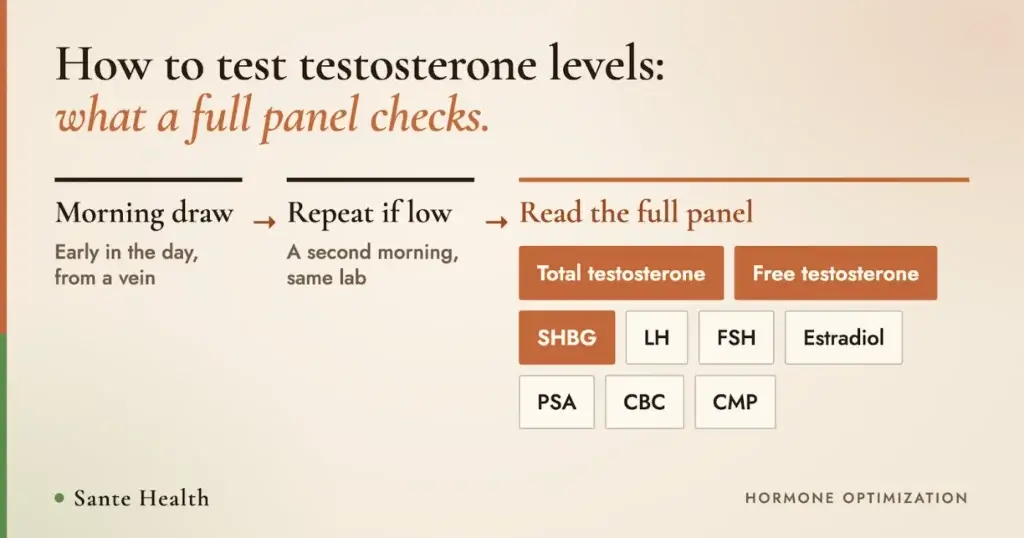
To test testosterone levels, you need a blood draw in the early morning, repeated on a second morning if the first result is low, and read with free testosterone, SHBG and the markers that explain the number. One total testosterone value can’t show how much your body can use or why it’s low.
How Do You Test Testosterone Levels Accurately?
The method the major guidelines rely on is a blood sample from a vein, taken early in the morning, when testosterone runs highest. The American Urological Association (AUA) calls for two total testosterone measurements on separate early mornings, preferably at the same lab using the same method. The Endocrine Society asks for a fasting morning draw, confirmed by repeating it.
A few details change what the result means:
- Book the earliest slot you can. An afternoon draw can read lower than the same man’s morning level.
- Ask whether to fast. The Endocrine Society specifies fasting, and some ordering clinicians do too.
- Wait out an acute illness. Guidelines generally call for testing when you’re well.
- Use the same lab for the repeat. Testing methods differ, and a change of lab can move the number.
- List everything you take. Some medications affect testosterone, and biotin supplements can interfere with some lab assays. Keep taking your medications unless your clinician tells you otherwise.
Why Is One Testosterone Result Not Enough?
Testosterone moves through the day and from one day to the next, so a single draw can land low in a man whose levels aren’t consistently low. The AUA treats total testosterone below 300 ng/dL as a reasonable cutoff for low testosterone, applied only when two early-morning results and symptoms or signs line up. The Endocrine Society works from a harmonized range of 264 to 916 ng/dL, measured in healthy, nonobese men aged 19 to 39.
Those figures differ, and your lab’s printed range may differ from either. A result of 280 ng/dL sits below the AUA line and above the Endocrine Society’s lower limit, which is one reason a number near the edge calls for a repeat and a free testosterone reading.
What Is Free Testosterone?
Free testosterone is the testosterone in your blood that isn’t attached to a protein, which makes it the portion your body can use most easily. Most circulating testosterone is bound to sex hormone-binding globulin (SHBG) or albumin. A total testosterone test counts bound and free together.
SHBG is why total and free can disagree. Obesity and diabetes tend to lower SHBG, which can pull total testosterone down while free testosterone holds. Aging, liver disease and an overactive thyroid tend to raise it, so total can look normal while free runs low.
The Endocrine Society recommends adding free testosterone when total sits near the lower limit or when a condition has likely shifted SHBG. Labs either measure it directly or calculate it from total testosterone, SHBG and albumin. The albumin value comes from a comprehensive metabolic panel.
What Does a Full Testosterone Panel Check?
A full panel reads how much testosterone is present, how much is available, what signal the brain is sending, and what a clinician needs on record before any treatment. The published initial panel for Men’s Hormone Optimization at Sante Health covers these markers:
| Marker | What it shows |
|---|---|
| Total testosterone | All testosterone in the blood, bound and free |
| Free testosterone | The unbound portion, most available to your body |
| SHBG | The main binding protein, used to read total against free |
| LH and FSH | The pituitary signals to the testes, which help separate a testicular cause from a pituitary one |
| Estradiol | An estrogen the body makes partly from testosterone |
| PSA | A prostate marker, recorded as a baseline before treatment and tracked during it |
| CBC | Red cell count and hematocrit, which testosterone therapy can raise |
| CMP | Liver, kidney and glucose values, plus albumin |
Thyroid function, a lipid profile, hemoglobin A1c (HbA1c) and ferritin are added when clinically relevant. At Sante Health, the panel starts with a morning draw, and a low result is repeated to confirm it before treatment is discussed.
Which Other Markers Explain a Low Number?
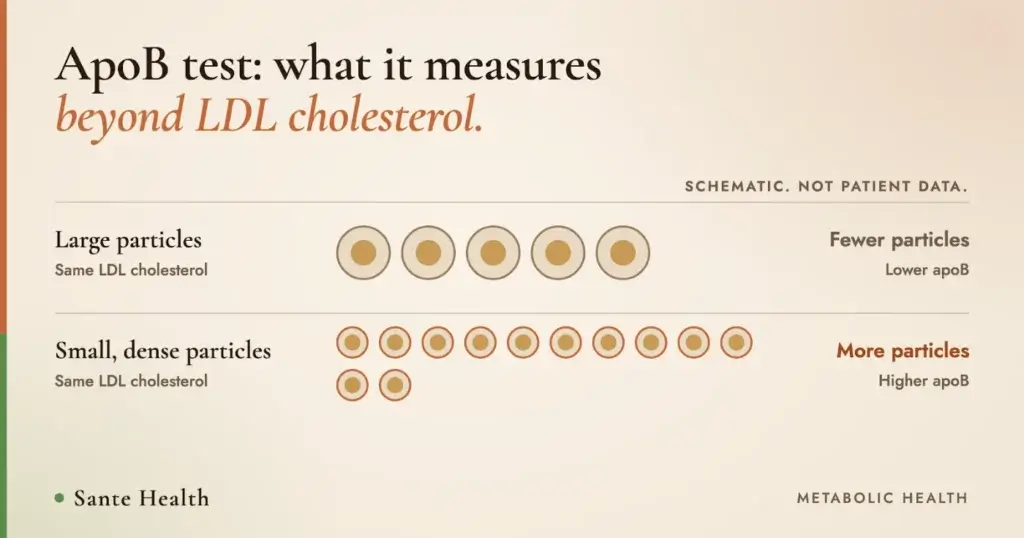
Metabolic markers can explain the number, because insulin resistance and visceral fat are closely linked with lower testosterone. Fasting insulin and HbA1c show the insulin side, and our guide to the tests that catch insulin resistance early covers what each one measures.
Men who want that read in one round of labs can start with the Comprehensive Metabolic Assessment. It measures total and free testosterone, SHBG and estradiol next to fasting insulin, HbA1c, a lipid panel with apoB, and a full thyroid panel, and it includes a 90-minute results consultation.
Sleep, stress physiology and medications get reviewed as well, since a lab value alone can’t account for them.
How Can You Check Testosterone Levels at Home?
Home kits use a finger-prick blood sample or saliva that you mail to a lab. The AUA cutoff is written for serum total testosterone drawn in the early morning, so read a kit result as a reason to get a morning draw from a vein. A kit that reports only total testosterone has the same limit as any single draw: no SHBG, LH, FSH or second morning.
What Happens After the Panel at Sante Health?
Lovelle Valencia, NP, FNP, PMHNP, reviews your results with you by telehealth and explains what each marker indicates. In The Sante Method’s ADORE framework (Assess, Decode, Optimize, Refine, Empower), this is the Decode step. Lovelle makes the prescribing, lab and titration decisions directly.
Hormone therapy is only an option when your symptoms, lab work and full evaluation support it, and it stays clinician-supervised. A history of prostate cancer, untreated obstructive sleep apnea, uncontrolled polycythemia, or plans to conceive soon without a fertility-preserving protocol can change the answer, and those get discussed at consultation.
When treatment is part of the plan, follow-up labs run at 6 to 8 weeks, then at 3 and 6 months, then annually once stable. They track hematocrit, PSA and estradiol, along with how you’re feeling. Delivery can be injections, topical cream or pellets. Hormone Pellet Therapy is the one in-office step, a brief insertion at the Westlake Village office. Everything else runs by telehealth, with labs drawn at a local site.
Frequently Asked Questions
Is testosterone included in a normal blood test?
Usually not. A routine comprehensive metabolic panel, CBC and lipid panel don’t measure testosterone, so it has to be ordered on its own. Ask for total testosterone at minimum, and free testosterone and SHBG when you can.
What is the difference between total and free testosterone?
Total testosterone counts everything in the blood, bound and unbound. Free testosterone counts only the unbound portion, which your body can use most easily. Reading them with SHBG shows whether a total result reflects what’s available.
What testosterone level is considered low?
The AUA uses total testosterone below 300 ng/dL as a reasonable cutoff, on two early-morning draws with symptoms or signs. The Endocrine Society’s harmonized lower limit is 264 ng/dL. Labs print their own ranges, so a clinician reads your number against the method used.
Do you need to fast before a testosterone blood test?
Sometimes. The Endocrine Society specifies a fasting morning draw, and some clinicians and labs ask for several hours of fasting, with water allowed. Follow the instructions on your lab order.
Can I get a testosterone panel without visiting an office?
Yes. Sante Health orders the panel to a draw site near you and reviews the results by telehealth across California. The Westlake Village office is used for in-office procedures such as pellet insertion, by appointment.
How much does a men’s hormone panel cost?
Pricing varies by panel and is reviewed at your initial visit. Sante Health is a cash-pay practice, and superbills may be provided for select visit types so you can submit to your carrier for potential out-of-network reimbursement.
Book a Men’s Hormone Consultation
Sante Health reads your testosterone with free testosterone, SHBG, LH, FSH and the rest of the men’s panel before any treatment conversation. The office is in Westlake Village, and care is delivered by telehealth across California.
Or call 805-370-0000.
About the author. Lovelle Valencia, NP, FNP, PMHNP is a board-certified Nurse Practitioner with specialized training in functional medicine (IFM), metabolic health (A4M), and psychiatric mental health. Professional affiliations: AANP, ANCC, A4M, IFM.
This article is for informational purposes only and does not constitute medical advice, diagnosis, or treatment. Consult a qualified healthcare provider for personalized guidance.