An hs-CRP test measures C-reactive protein, a protein your liver releases in response to inflammation, at the low levels a standard CRP test can’t resolve. Those low levels move with insulin resistance, visceral fat, and disrupted sleep, which makes hs-CRP a metabolic marker as well as a cardiovascular one. A routine comprehensive metabolic panel doesn’t include it.
What Is an hs-CRP Test?
An hs-CRP test is a blood test for high-sensitivity C-reactive protein, a general marker of inflammation, reported in milligrams per liter (mg/L) and precise to fractions of 1 mg/L. That precision is what lets it describe the low-grade, persistent inflammation linked to cardiovascular and metabolic risk.
C-reactive protein is made in the liver. Its production is switched on mainly by interleukin-6 (IL-6), a signaling molecule released by immune cells and by fat tissue. CRP has a plasma half-life of about 19 hours that stays constant in health and illness, so the level in a sample reflects how much the liver is producing at the time of the draw (Pepys and Hirschfield, Journal of Clinical Investigation, 2003).
hs-CRP has to be ordered on purpose, because routine annual bloodwork carries no inflammation marker. It sits on the short list of markers routine bloodwork leaves out, alongside fasting insulin.
How Is hs-CRP Different From a Standard CRP Test?
Both tests measure the same protein. What differs is the range each one reads accurately. A standard CRP test is built for the high range, where an infection, injury, or inflammatory flare can push CRP into the tens or hundreds of mg/L. The hs-CRP assay is built for the low range below 10 mg/L, where persistent low-grade inflammation sits.
| Standard CRP | hs-CRP | |
|---|---|---|
| Built to detect | Acute inflammation from infection, injury, or an inflammatory flare | Persistent, low-grade inflammation |
| Range it reads well | Higher values, from several mg/L up into the hundreds | Fractions of 1 mg/L up to about 10 mg/L |
| Typical use | Tracking an acute illness or a known inflammatory condition | Cardiovascular risk and metabolic context |
The difference shows up on the report. A standard CRP result is often printed only as a cutoff, such as “<5 mg/L”, which can’t tell 0.4 from 4.0. A result like that can’t place you in a risk tier, so an older CRP on file rarely stands in for an hs-CRP.
What Do hs-CRP Results Mean?
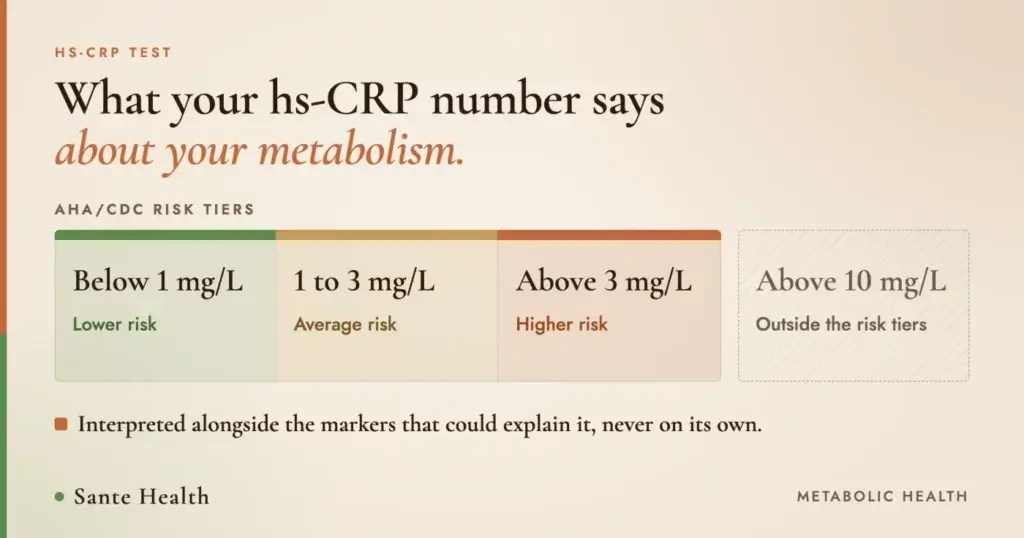
hs-CRP results are read in three tiers from a 2003 joint scientific statement by the American Heart Association (AHA) and the CDC: below 1 mg/L is lower cardiovascular risk, 1 to 3 mg/L is average, and above 3 mg/L is higher. A result above 10 mg/L falls outside the tiers and usually reflects a short-term cause.
| hs-CRP result | AHA/CDC category | How it’s read |
|---|---|---|
| Below 1.0 mg/L | Lower risk | Little low-grade inflammatory signal |
| 1.0 to 3.0 mg/L | Average risk | Read against insulin, lipids, and waist to see which way it’s heading |
| Above 3.0 mg/L | Higher risk | Persistent low-grade inflammation, if it holds on a repeat draw |
| Above 10 mg/L | Outside the risk tiers | Usually an infection or injury; repeated once it resolves |
The 2018 AHA/ACC cholesterol guideline adds a second cut point: an hs-CRP of 2.0 mg/L or higher is listed as a risk-enhancing factor when a clinician weighs cardiovascular risk.
Any single result has two limits. hs-CRP rises the same way whether the source is visceral fat, a gum infection, or a head cold, so it can’t show where inflammation is coming from. And it describes the day of the draw, which is why the tiers assume a repeat measurement.
Why Does hs-CRP Move With Insulin Resistance, Visceral Fat, and Sleep?
hs-CRP rises when the liver receives more of the signals that switch CRP production on, and three metabolic conditions send those signals. Visceral fat releases IL-6 on a direct route to the liver, insulin resistance comes with a low-grade inflammatory state, and disrupted sleep is associated with higher inflammatory markers.
Visceral fat sends IL-6 straight to the liver
Visceral fat, the fat packed around the abdominal organs, drains into the portal vein, which runs directly to the liver. Fontana and colleagues, writing in Diabetes in 2007, sampled portal vein blood during surgery in people with severe obesity. The portal blood carried more IL-6 than arterial blood, and portal IL-6 tracked with CRP levels throughout the body. Waist circumference is the practical stand-in for visceral fat, which is why hs-CRP is checked alongside a waist measurement.
Insulin resistance and CRP rise together
Festa and colleagues, reporting from the Insulin Resistance Atherosclerosis Study in Circulation in 2000, found that among adults without diabetes, CRP rose as directly measured insulin sensitivity fell. The relationship appears to run both ways. Inflammatory signaling blunts how cells respond to insulin, and the fat tissue that expands alongside insulin resistance produces more inflammatory signals. That’s why hs-CRP and fasting insulin so often move together, and why one is rarely interpreted without the other.
Disrupted sleep is linked to higher inflammatory markers
A 2016 meta-analysis by Irwin and colleagues in Biological Psychiatry found that sleep disturbance was associated with higher CRP and IL-6. A draw taken at the end of a week of poor sleep may read above your usual level, so the sleep history around a draw is part of interpreting the number.
How Is hs-CRP Read Alongside Other Metabolic Markers?
hs-CRP is interpreted alongside the markers that could explain it, never on its own. The same result means one thing beside a rising fasting insulin and a widening waist, and something else a week after a cold.
| What sits beside hs-CRP | How the pattern reads |
|---|---|
| Rising fasting insulin or HOMA-IR, a climbing triglyceride-to-HDL ratio, a growing waist | Inflammation moving with insulin resistance; the metabolic drivers are the first place to look |
| Normal insulin markers and a recent illness, injury, dental work, or hard training block | Likely short-term; repeated before anything is read into it |
| High ferritin | Ferritin also rises with inflammation, so iron stores are read cautiously until hs-CRP settles |
| Low hs-CRP with rising fasting insulin | Insulin resistance can build before inflammation shows; the insulin markers lead |
| A steady result across several draws | A reliable personal baseline, and the reference for every later result |
Fasting insulin and HOMA-IR anchor most of these patterns, and both are covered in the tests that detect insulin resistance.
What Happens After an Elevated hs-CRP Result?
Four questions decide what an elevated hs-CRP result means for you. In The Sante Method’s ADORE framework (Assess, Decode, Optimize, Refine, Empower), that work happens in Decode, the step where lab results become an explanation of what’s driving them.
- Is it steady or short-term? The two weeks before the draw are reviewed for illness, injury, dental work, a hard training block, and poor sleep. A likely short-term cause means a repeat draw before any conclusion.
- What is it moving with? The result is placed beside fasting insulin, HbA1c, the lipid pattern, ferritin, and waist measurement to see whether it fits a metabolic picture.
- Is it changing? The value is compared with your own prior results, since direction over time carries as much weight as the tier.
- What changes in the plan? When hs-CRP moves with insulin resistance and visceral fat, the Optimize plan addresses those drivers first, through levers such as sleep, protein and fiber at meals, and resistance training. hs-CRP is then rechecked to confirm it moved.
A result in the acute range, or any result drawn alongside fever, pain, or feeling unwell, goes to your primary care clinician first. The Comprehensive Metabolic Assessment is built for the persistent, low-grade picture and how it connects to the rest of your metabolism.
When Should You Retest hs-CRP?
Retest hs-CRP when the first result could reflect a short-term cause, and again at reassessment to see whether it moved. The 2003 AHA/CDC statement recommends measuring twice, ideally two weeks apart, and averaging the two before assigning a risk tier. It also recommends repeating any acute-range result after looking for a source of infection or inflammation.
- Test while you’re well. Wait until you’ve recovered from an illness, injury, or dental procedure before the draw.
- Skip hard exercise the day before. Strenuous training can raise CRP for a short time and inflate the result.
- Recheck it with the markers it moves with. In the Refine stage, hs-CRP is repeated on the same schedule as insulin, lipids, and waist measurement, so a change in one can be read against changes in the others.
Frequently Asked Questions
Do you need to fast for an hs-CRP test?
No. The AHA/CDC guidance allows fasting or nonfasting draws. When hs-CRP is part of a panel that includes fasting insulin or lipids, it’s drawn from the same fasted morning sample, so every marker describes the same day.
What hs-CRP level is too high?
Above 3 mg/L is the higher cardiovascular risk tier. Above 10 mg/L usually reflects an acute cause such as an infection or injury, and the test is repeated after you’ve recovered. Any high result alongside fever, pain, or feeling unwell should go to your primary care clinician promptly.
What else can raise hs-CRP besides metabolism?
Acute infections, injuries, recent surgery, hard exercise, smoking, gum disease, and autoimmune or inflammatory conditions all raise it. Medications shift it too: oral estrogen tends to raise hs-CRP and statins tend to lower it, so your medication list is part of interpreting the result.
Can a high hs-CRP come down?
Often, when its driver changes. A 2007 systematic review by Selvin and colleagues in Archives of Internal Medicine found CRP fell by about 0.13 mg/L for every kilogram of weight lost. Sleep, regular activity, and improving insulin sensitivity are the other common levers, and a repeat draw shows whether it moved.
Is hs-CRP the same as an inflammation blood test?
It’s one of several, and the one built for low-grade inflammation. Standard CRP and the erythrocyte sedimentation rate (ESR) are inflammation blood tests used mainly for infections and inflammatory conditions. hs-CRP measures the low range where metabolic and cardiovascular risk sit.
Is hs-CRP included in routine blood work?
Usually not. A standard physical runs a comprehensive metabolic panel, blood count, and lipid panel, and none of them include it. The US Preventive Services Task Force concluded in 2018 that the evidence was insufficient to add hs-CRP to standard cardiovascular risk assessment in adults without symptoms.
Can I get an hs-CRP test at Sante Health?
Yes. hs-CRP is one of the inflammatory markers in the Comprehensive Metabolic Assessment. Labs are drawn locally and reviewed in a 90-minute telehealth consultation with Lovelle Valencia, NP. Pricing varies by panel, and care is available by telehealth across California.
How to Get an hs-CRP Test Read With Your Metabolic Markers
The Comprehensive Metabolic Assessment at Sante Health measures hs-CRP alongside fasting insulin, particle-level lipids, full thyroid, and nutrient status, then reviews them with you as one pattern, with the clinician who ordered them. The office is in Westlake Village, in the Conejo Valley, and metabolic care at Sante Health is delivered by telehealth across California.
Or call 805-370-0000.
About the author. Lovelle Valencia, NP, FNP, PMHNP is a board-certified Nurse Practitioner with specialized training in functional medicine (IFM), metabolic health (A4M), and psychiatric mental health. Professional affiliations: AANP, ANCC, A4M, IFM.
This article is for informational purposes only and does not constitute medical advice, diagnosis, or treatment. Consult a qualified healthcare provider for personalized guidance.