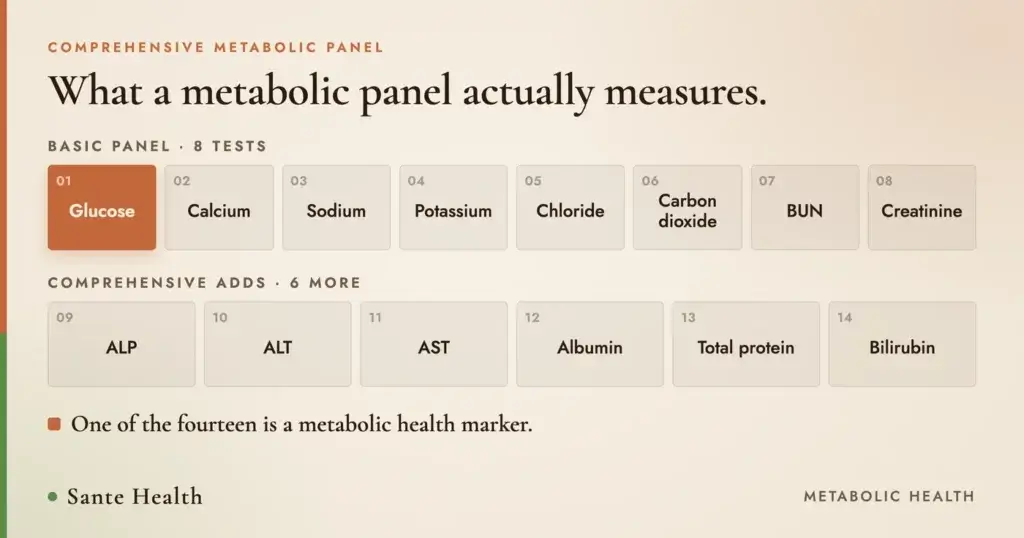
A comprehensive metabolic panel (CMP) is a routine blood test that measures 14 substances in a single sample: glucose, calcium, four electrolytes, two kidney markers, three liver enzymes, two proteins, and bilirubin. It is a check on organ function and fluid balance. Only one of those 14 is a metabolic health marker.
What Is on a Metabolic Panel?
There are two versions, and the difference between them is six tests.
A basic metabolic panel (BMP) measures eight substances. A comprehensive metabolic panel (CMP) measures those same eight plus six more that look at the liver and at blood proteins.
| # | Test | What it looks at |
|---|---|---|
| 1 | Glucose | Blood sugar at the moment of the draw |
| 2 | Calcium | A mineral central to nerve, muscle, and heart function |
| 3 | Sodium | Fluid balance and nerve signaling |
| 4 | Potassium | Nerve and muscle function, including cardiac rhythm |
| 5 | Chloride | Fluid and acid-base balance |
| 6 | Carbon dioxide (bicarbonate) | Acid-base balance |
| 7 | Blood urea nitrogen (BUN) | A waste product cleared by the kidneys |
| 8 | Creatinine | A waste product used to estimate kidney filtration |
| 9 | Alkaline phosphatase (ALP) | An enzyme from liver and bone |
| 10 | Alanine transaminase (ALT) | A liver enzyme, raised when liver cells are stressed |
| 11 | Aspartate transaminase (AST) | An enzyme from liver and muscle |
| 12 | Albumin | The main protein in blood, made by the liver |
| 13 | Total protein | Albumin plus globulins |
| 14 | Bilirubin | A pigment from red cell breakdown, cleared by the liver |
Tests 1 through 8 are the basic panel. Tests 9 through 14 are what makes it comprehensive.
Two more values usually appear on the report without being separate tests. eGFR, an estimate of kidney filtration rate, is calculated from creatinine along with age and sex. Anion gap is calculated from the electrolytes. Neither costs an extra draw.
Why Would a Doctor Order a Metabolic Panel?
For three reasons, and none of them is metabolic health in the sense most people mean it.
Screening. It is part of the standard annual physical, alongside a complete blood count, a lipid panel, and a TSH. It gives a fast, broad look at organ function.
Diagnosis. When symptoms suggest a kidney, liver, or electrolyte problem, this is the panel that goes out first. Severe fatigue, swelling, nausea, and confusion are all reasons to run it.
Monitoring. This is the most common reason of all, and the least discussed. Many prescription medications require periodic kidney and liver checks, and the CMP is the instrument for that. Plenty of people have a CMP on file every six months purely because of a medication they take.
Judged against those three jobs, the panel is well designed and it does them well. It reliably detects kidney impairment, liver injury, dangerous electrolyte shifts, and established diabetes.
What Does a Metabolic Panel Not Measure?
The list is longer than most people expect, and the first item on it usually causes the most surprise.
- Cholesterol. A comprehensive metabolic panel contains no lipids at all. Total cholesterol, LDL, HDL, and triglycerides come from a separate lipid panel. The word “comprehensive” describes the panel’s own scope, not your bloodwork’s.
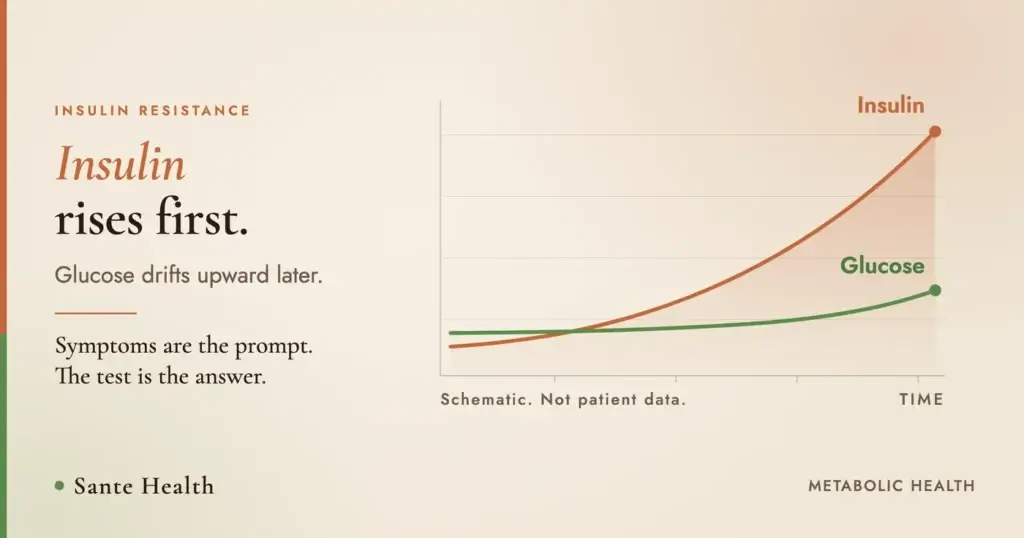
- Insulin. Nothing on the CMP measures the effort required to keep glucose in range, which is the first thing to change in most metabolic decline.
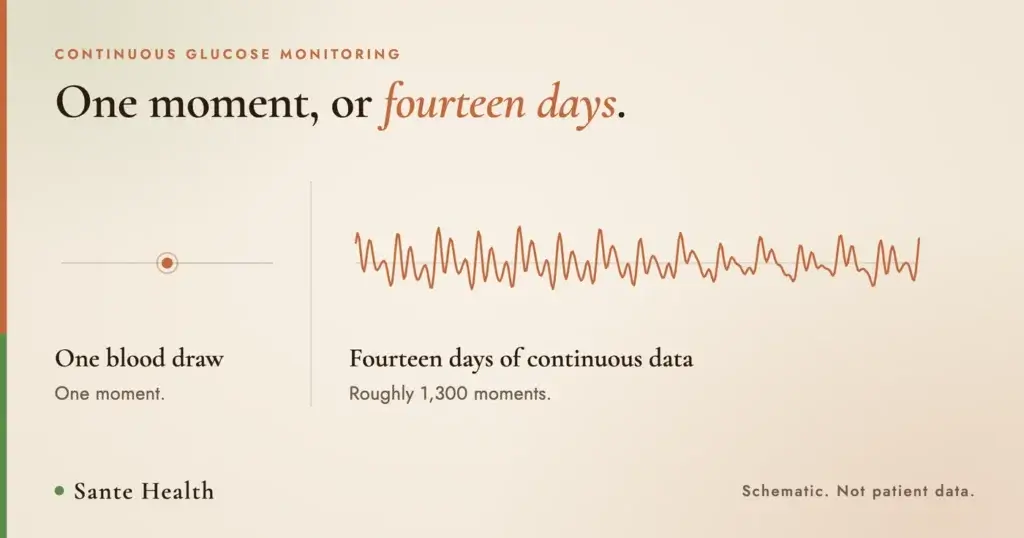
- HbA1c. Glucose on a CMP is a single moment. The three-month average is a separate test.
- Thyroid. No TSH, no free T3, no free T4.
- Inflammation. No hs-CRP or any other inflammatory marker.
- Nutrients. No vitamin D, B12, ferritin, or magnesium.
- Sex hormones. Nothing on testosterone, estradiol, or progesterone.
None of that is a flaw. It is a scope decision made when the panel was designed, for a panel built to detect established organ disease rather than to describe how efficiently your metabolism is running. Those two questions have different markers attached to them, which is covered in the markers a routine panel leaves out.
Metabolic Panel vs. Comprehensive Metabolic Assessment
The names are almost identical and they describe different things. This is the confusion worth resolving, because people book one expecting the other.
The word “metabolic” is doing different work in each. On a CMP it means metabolism in the broad biochemical sense: how your body handles fluids, electrolytes, proteins, and waste. In “metabolic health” it means the cardiometabolic sense: insulin regulation, glucose control, lipid particles, inflammation, and how efficiently you convert food into stable energy.
| Comprehensive metabolic panel | Comprehensive metabolic assessment | |
|---|---|---|
| What it is | One standard lab test, 14 analytes | A set of labs chosen together, then interpreted as one pattern |
| Primary purpose | Detect organ dysfunction and monitor medication | Describe how your metabolism is functioning |
| Glucose | Yes, one fasting value | Yes, plus fasting insulin, HOMA-IR, and HbA1c |
| Lipids | None | Full lipid panel plus particle-level markers such as apoB |
| Thyroid | None | TSH plus free T3 and free T4 |
| Inflammation | None | hs-CRP and related markers |
| Nutrients | Calcium only | Vitamin D, B12, ferritin, magnesium |
| What you get back | Values compared to a population reference range, one at a time | A clinician’s read of the pattern across systems, against your own prior results |
| How it is ordered | Routine, usually part of an annual physical | Deliberately, with the panel selected to your history |
The practical difference is the “what you get back” row. A CMP is returned as a column of numbers with flags next to any that fall outside a reference range. Nobody reads the relationships between them, because that is not what the test is for. A Comprehensive Metabolic Assessment is built around that reading step, which is why the visit happens after the labs rather than before.
If you want the shorter version of which markers matter and why, how metabolic health is actually measured covers the five standard criteria and the four that add resolution beyond them.
Do You Need to Fast Before a Metabolic Panel?
Usually yes, though it depends on what your clinician wants from it.
Fasting for 8 to 12 hours, water permitted, is standard when the glucose value is going to be interpreted or when a lipid panel is being drawn at the same time. A CMP ordered purely to check kidney or liver function does not strictly require it, and your ordering clinician should tell you which situation applies.
Two other things are worth knowing before the draw. Hard exercise in the preceding day can raise several values, including AST and creatinine, so a heavy session the night before can produce a flag that means nothing. And dehydration concentrates the sample, which nudges BUN, creatinine, and albumin upward. Drink water, skip the workout, and the result describes you rather than your Tuesday.
Frequently Asked Questions
What are the 14 tests in a comprehensive metabolic panel?
Glucose, calcium, sodium, potassium, chloride, carbon dioxide, BUN, creatinine, ALP, ALT, AST, albumin, total protein, and bilirubin. The first eight make up a basic metabolic panel; the last six add liver and protein detail.
What is the difference between a basic and a comprehensive metabolic panel?
Six tests. The basic panel covers glucose, calcium, four electrolytes, and two kidney markers. The comprehensive panel adds three liver enzymes, albumin, total protein, and bilirubin, giving a fuller picture of liver function.
Does a metabolic panel check cholesterol?
No. A comprehensive metabolic panel contains no lipids at all. Cholesterol, HDL, LDL, and triglycerides come from a separate lipid panel, which is usually drawn at the same visit but ordered as its own test.
Can a metabolic panel detect insulin resistance?
Not reliably. It measures fasting glucose but not fasting insulin, and glucose typically stays in range for years while insulin rises to hold it there. Detecting insulin resistance takes fasting insulin, HOMA-IR, or a glucose tolerance test with insulin.
What does it mean if a value on my metabolic panel is out of range?
It means the value sits outside the range where most results in a reference population fall. That can reflect a real problem, a medication, dehydration, or a recent workout. A single flagged value is a reason to ask your clinician, not a diagnosis.
Should I ask for a metabolic panel or a metabolic assessment?
If the question is whether your kidneys and liver are working, a metabolic panel answers it. If the question is why you feel depleted while your labs read normal, a comprehensive metabolic assessment is the one built for that.
How to Get a Fuller Metabolic Picture
A comprehensive metabolic panel is a good test that answers a specific question. If your question is a different one, the panel will keep coming back normal, because it is not looking where you are asking.
The Comprehensive Metabolic Assessment at Sante Health adds fasting insulin, inflammatory markers, particle-level lipids, full thyroid, and nutrient status, then spends a 90-minute telehealth visit on interpretation. If insulin regulation is the specific thing you want ruled in or out, which tests actually detect insulin resistance sets out the shorter list.
Sante Health delivers metabolic care by telehealth across California, with labs drawn locally and results reviewed with the clinician who ordered them.
Or call 805-370-0000.
About the author. Lovelle Valencia, NP, FNP, PMHNP is a board-certified Nurse Practitioner with specialized training in functional medicine (IFM), metabolic health (A4M), and psychiatric mental health. Professional affiliations: AANP, ANCC, A4M, IFM.
This article is for informational purposes only and does not constitute medical advice, diagnosis, or treatment. Consult a qualified healthcare provider for personalized guidance.