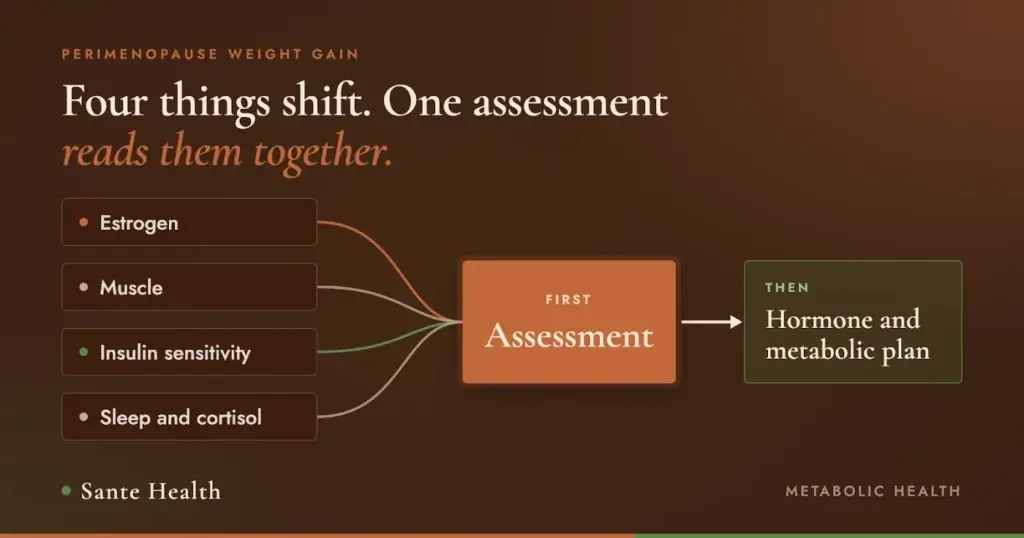
Perimenopause weight gain is a metabolic change as well as a hormonal one. Before the final period, estrogen turns erratic, muscle declines, insulin sensitivity falls, and sleep and cortisol shift. Together, those changes move fat toward the abdomen. Each driver can be measured, so the plan starts with an assessment, then addresses hormones and metabolism together.
When Does Perimenopause Weight Gain Start?
Perimenopause weight gain usually starts in the menopause transition, the stretch of irregular cycles that begins for most women in their 40s and ends 12 months after the final period. The average age of that final period in the United States is 51.
The Study of Women’s Health Across the Nation (SWAN), which has followed more than 3,000 women through midlife, measured when the change in body composition begins. Greendale and colleagues, reporting in JCI Insight in 2019, found that the rate of fat gain roughly doubled and lean mass began to decline once the transition started. Both leveled off about two years after the final period, and weight and waist circumference followed the same curve.
Because the change starts while periods are still coming, it often shows up before anyone has connected it to perimenopause. A doubled rate of fat gain, alongside falling muscle, is why weight gain in perimenopause can feel sudden or rapid. Sudden gain with no clear explanation is still worth checking with a clinician, because an underactive thyroid can look similar (see the thyroid question in the FAQ below).
What Shifts in Your Metabolism During Perimenopause?
Four things shift during perimenopause, and each one changes how the body stores and uses energy: estrogen, muscle, insulin sensitivity, and the sleep and stress system.
Estrogen swings, then falls
Estradiol rises and drops from cycle to cycle in perimenopause, sometimes running higher than before, and settles low only after menopause. Estrogen favors fat storage on the hips and thighs and supports insulin sensitivity, so as it falls, storage moves toward the abdomen. Lovejoy and colleagues, in the International Journal of Obesity in 2008, followed women for four years with imaging and found visceral fat, the fat packed around the organs, increased across the transition.
Muscle declines
SWAN found lean mass begins to fall at the start of the transition. Skeletal muscle clears about 80% of the glucose the body takes up under insulin’s direction (DeFronzo and Tripathy, Diabetes Care, 2009), so less muscle means each meal needs more insulin to handle the same glucose.
Insulin sensitivity falls
Insulin resistance tends to build across the transition. In SWAN, Janssen and colleagues (Archives of Internal Medicine, 2008) found that metabolic syndrome, the cluster of a larger waist, high triglycerides, low HDL, higher blood pressure and higher glucose, became more common as women moved through menopause, independent of age. Fasting glucose can stay normal for years while this happens, which is why fasting insulin matters, as covered in the tests that catch insulin resistance before glucose rises.
Sleep breaks up and cortisol rises
Feeling hungry much of the time is common in perimenopause, and broken sleep is one measured reason: short sleep lowers leptin, the fullness hormone, and raises ghrelin, the hunger hormone (Spiegel and colleagues, Annals of Internal Medicine, 2004). In SWAN’s community survey, 38% of women aged 40 to 55 reported sleep difficulty, with the highest rates in late perimenopause (Kravitz and colleagues, Menopause, 2003). Night sweats are a common cause. The Seattle Midlife Women’s Health Study found overnight cortisol rose in the late transition stage (Woods and colleagues, Menopause, 2009), and cortisol favors fat storage in the abdomen.
Why Does the Same Diet Stop Working in Perimenopause?
The same diet stops working because the body it feeds has changed: it burns less energy, holds less muscle, needs more insulin for the same meal, and gets hungrier on short sleep. Lovejoy’s group measured the energy side directly. Women who reached postmenopause during the study showed lower 24-hour energy expenditure and burned less fat than they had at the start.
| What changed | What it does to the old plan |
|---|---|
| Less muscle | Fewer calories burned at rest, less capacity to clear glucose after meals |
| Lower insulin sensitivity | The same carbohydrate load needs more insulin, which favors fat storage |
| Short or broken sleep | Appetite hormones move toward eating more |
| Higher cortisol | Fat storage shifts toward the abdomen |
| Falling estrogen | Fat distribution moves from the hips and thighs to the waist |
The sleep effect is large. In Spiegel’s controlled study of healthy young men, two nights of four hours’ sleep lowered leptin by 18%, raised ghrelin by 28%, and raised reported hunger by 24%.
Eating less is the usual response, and in this window it has a cost: steep calorie deficits take muscle along with fat, and muscle is the tissue the transition is already losing. Protecting muscle and protecting sleep come first. The 2018 Physical Activity Guidelines for Americans recommend muscle-strengthening activity on at least two days a week, and protein at each meal supports what that training builds.
Which Markers Are Worth Checking for Perimenopause Weight Gain?
The markers worth checking are the ones that show which driver is moving: insulin and glucose, lipids, inflammation, thyroid, hormones, nutrient status, and where fat and muscle sit. A routine physical covers fasting glucose and a basic lipid panel, and both can read normal while insulin resistance builds.
| Marker | What it shows in perimenopause |
|---|---|
| Fasting insulin and HOMA-IR | Insulin resistance, often years before fasting glucose rises |
| HbA1c and fasting glucose | The three-month glucose average and the morning baseline |
| Triglyceride-to-HDL ratio | A lipid pattern that climbs with insulin resistance |
| hs-CRP | Low-grade inflammation that moves with visceral fat and short sleep |
| Thyroid (TSH, free T4, free T3) | An underactive thyroid, which causes overlapping fatigue and weight change |
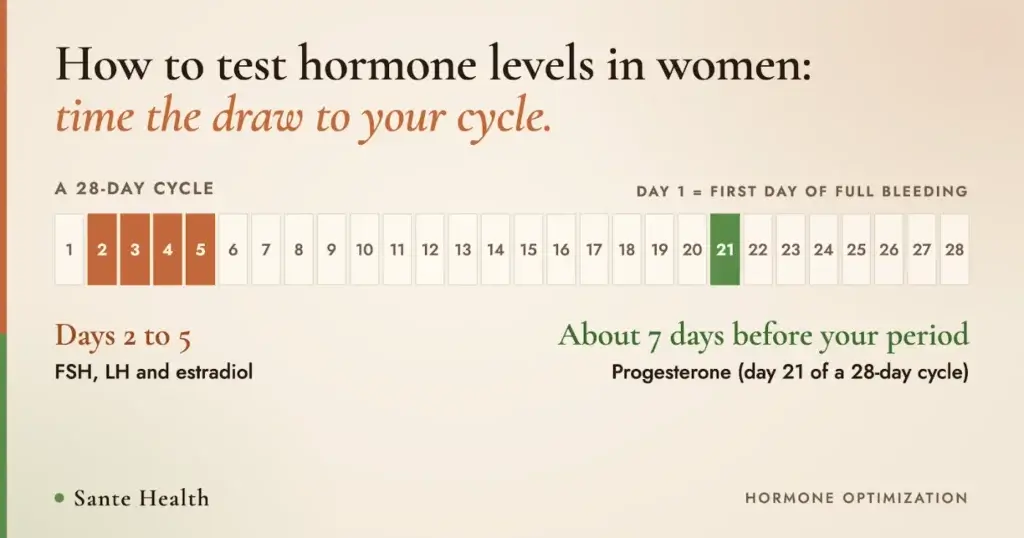
| Estradiol, progesterone and FSH | Where hormones sit on the day of the draw, read against symptoms |
| Ferritin, vitamin D and B12 | Nutrient status that shapes energy and the capacity to train |
| Waist circumference and body composition | Whether fat is moving to the abdomen and whether muscle is holding |
Hormone results need context in perimenopause because they swing. NICE guidance (NG23) advises against using an FSH test to confirm perimenopause or menopause in women over 45, since a single value can land anywhere in a changing cycle. Symptoms and cycle history lead, and hormone labs are read alongside them.
The Comprehensive Metabolic Assessment measures metabolic panels, inflammatory markers, hormone levels and nutrient status in one round of labs, and it’s the starting point for metabolic care at Sante Health. Lovelle Valencia, NP, FNP, PMHNP, reviews the hormone and metabolic results side by side, and the outcome is metabolic insight: which drivers are moving, and in what order to address them.
Where Do BHRT and Metabolic Care Fit?
BHRT and metabolic care work on different drivers, and the assessment shows which ones are in play. Perimenopause weight gain treatment is led by metabolic care, and BHRT plays a separate role for women who are candidates: relief of symptoms such as night sweats. When more than one driver is moving, the hormone plan and the metabolic plan are built from the same set of results, so neither is chosen in isolation.
Where BHRT fits
Bioidentical hormone replacement therapy (BHRT) uses hormones structurally identical to the ones the body makes, and it’s for women whose symptoms and history make them candidates. Its approved role is relief of menopause symptoms such as hot flashes and night sweats, and no hormone therapy is approved as a weight-loss treatment. The link to weight is indirect: when night sweats are breaking up sleep, relieving them addresses one of the drivers above.
Candidacy comes first. Lovelle reviews symptoms, cycle history, personal and family medical history, and hormone labs before recommending BHRT, and some histories, such as blood clots, stroke or a hormone-sensitive cancer, can rule it out. When it is part of the plan, Women’s BHRT at Sante Health is clinician-supervised, delivered by cream, sublingual dosing or pellets placed in the Westlake Village office, with symptom tracking at each follow-up.
Where metabolic care fits
Metabolic care works on the drivers hormones leave alone: insulin sensitivity, muscle, sleep habits, and an eating pattern that fits the new baseline. At Sante Health that is the Medical Weight Loss Program: metabolic screening, nutrition guidance, regular check-ins, and prescription medication management when it’s clinically appropriate.
How Does Telehealth Follow-Up Work?
Follow-up happens mostly by telehealth, on a secure, HIPAA-compliant platform, for women anywhere in California. In The Sante Method’s ADORE framework (Assess, Decode, Optimize, Refine, Empower), this is Refine: labs are rechecked on the schedule set in your plan, compared with your first results, and the plan is adjusted to what moved.
- BHRT follow-ups run 30 to 45 minutes and track symptoms alongside hormone labs.
- Weight-management check-ins run about 30 minutes and track insulin markers, waist and body composition.
- Office visits in Westlake Village are for procedures that need the office, such as pellet insertion and CGM placement.
More on how visits work is on the page for telehealth care at Sante Health.
Frequently Asked Questions
Is perimenopause weight gain the same as menopause weight gain?
People use both terms for the same change. Most of it happens during perimenopause, the transition before the final period, so “menopause weight gain” usually describes weight gained in the years leading up to menopause.
Why does perimenopause weight gain collect around the belly?
Falling estrogen moves fat storage from the hips and thighs toward the abdomen, and higher cortisol and insulin resistance favor the same place. Research that followed women through the transition found visceral fat, the fat around the organs, increased.
What is the average weight gain during perimenopause?
About 5 pounds on average, with a wide range. That figure comes from the Healthy Women Study, which followed women through the menopause transition, and some women in it gained far more. Body composition can shift more than the scale shows, because fat gain speeds up while muscle declines.
How long does perimenopause weight gain last?
The fastest gain runs from the start of the transition to about two years after the final period. SWAN found fat gain and muscle loss leveled off at that point. Weight already gained tends to stay until sleep, muscle, insulin sensitivity or eating patterns change.
Can hormone therapy help with perimenopause weight gain?
Only indirectly. No hormone therapy is approved for weight loss; BHRT relieves symptoms such as hot flashes and night sweats in women who are candidates. When night sweats disrupt sleep, relief can support the sleep that appetite and insulin depend on.
Can a blood test confirm perimenopause?
A single test can’t. Hormones swing from cycle to cycle, and NICE guidance advises against using an FSH test to confirm perimenopause in women over 45. Symptoms and cycle history lead, with hormone labs read alongside them.
Should thyroid be checked when weight changes in perimenopause?
Yes. An underactive thyroid causes fatigue, weight gain and cycle changes that overlap with perimenopause, and thyroid conditions become more common in midlife women. A full thyroid panel separates the two.
Can I get a perimenopause metabolic assessment at Sante Health?
Yes. The Comprehensive Metabolic Assessment measures metabolic panels, inflammatory markers, hormone levels and nutrient status. Labs are drawn locally and reviewed in a 90-minute telehealth consultation. Pricing varies by panel, and care is available by telehealth across California.
Book an Assessment for Perimenopause Weight Gain
The Comprehensive Metabolic Assessment at Sante Health reads your hormone and metabolic markers together, so the plan starts with the drivers that are moving for you. The office is in Westlake Village, in the Conejo Valley, and care is delivered by telehealth across California.
Or call 805-370-0000.
About the author. Lovelle Valencia, NP, FNP, PMHNP is a board-certified Nurse Practitioner with specialized training in functional medicine (IFM), metabolic health (A4M), and psychiatric mental health. Professional affiliations: AANP, ANCC, A4M, IFM.
This article is for informational purposes only and does not constitute medical advice, diagnosis, or treatment. Consult a qualified healthcare provider for personalized guidance.