An ApoB test measures apolipoprotein B, the protein that sits on every LDL, VLDL and IDL particle, one per particle, so the result is a count of the cholesterol-carrying particles in your blood. LDL cholesterol measures how much cholesterol the LDL particles carry. The two usually agree, and they split most often with insulin resistance and high triglycerides.
What Does an ApoB Test Measure?
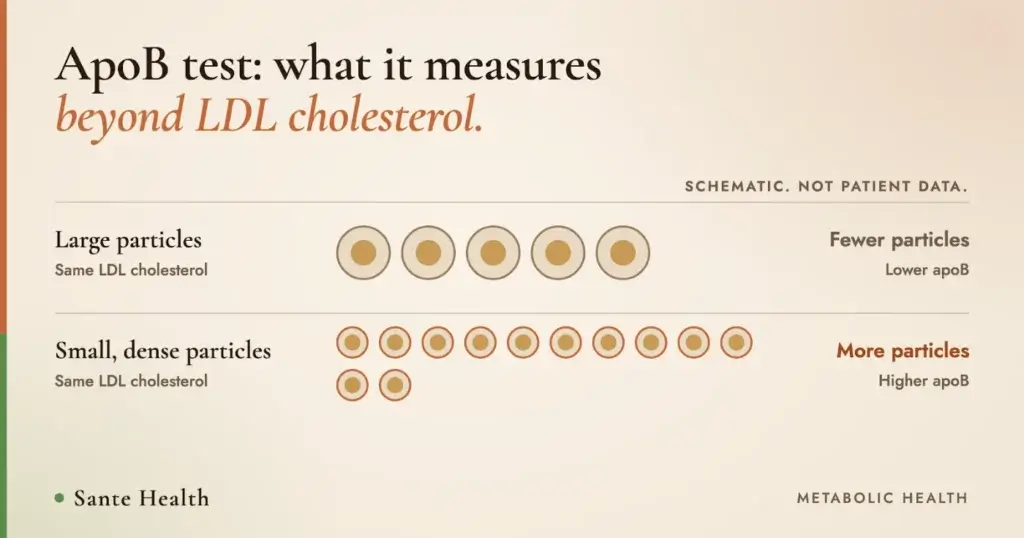
ApoB measures particle number. Every particle in the LDL, VLDL and IDL families carries exactly one apoB molecule, whatever its size and however much cholesterol it holds, so the apoB level reads as a head count. The 2026 ACC/AHA multisociety dyslipidemia guideline describes apoB as a direct measure of atherogenic particle number and LDL cholesterol as the cholesterol mass inside LDL particles.
| Marker | What it measures |
|---|---|
| LDL cholesterol (LDL-C) | The cholesterol inside LDL particles, often calculated from the other lipid values |
| Non-HDL cholesterol | All the cholesterol outside HDL, in LDL, VLDL and IDL together |
| ApoB | The number of LDL, VLDL, IDL and Lp(a) particles, one apoB per particle |
| LDL-P | The number of LDL particles specifically |
Why Can ApoB and LDL Cholesterol Disagree?
They disagree when particles carry less cholesterol than usual. Insulin resistance raises triglycerides and shifts LDL toward small, dense particles, each holding less cholesterol. The same amount of LDL cholesterol is then spread across more particles, so LDL-C reads normal while apoB reads high.
The opposite split happens too. Large, cholesterol-rich particles can push LDL-C up while the particle count, and the apoB, stays moderate. The 2026 guideline reports that when the two disagree, apoB predicts cardiovascular risk more accurately than LDL-C.
Who Is Most Likely to Have a High ApoB With a Normal LDL?
The split shows up most in the people whose lipids are shaped by insulin resistance. The 2026 ACC/AHA guideline says apoB testing can be useful particularly in adults with:
- Triglycerides of 150 mg/dL or higher
- Diabetes
- LDL cholesterol already below 70 mg/dL
A triglyceride-to-HDL ratio that keeps climbing, a waist that is growing, or fasting insulin that is rising point the same way, because they track the insulin resistance behind the split. Our guide to the tests that catch insulin resistance early covers those markers one by one.
What Is an Advanced Lipid Panel?
An advanced lipid panel adds particle-level measures, such as apoB and LDL-P, to the standard four values: total cholesterol, LDL-C, HDL-C and triglycerides. The standard panel reports cholesterol amounts. The advanced panel adds how many particles carry them.
A routine physical rarely includes apoB, and a comprehensive metabolic panel includes no lipids at all, so apoB has to be ordered on its own or as part of a wider panel.
How Does the Comprehensive Metabolic Assessment Read ApoB?
The Comprehensive Metabolic Assessment at Sante Health includes a lipid panel with apoB and LDL-P, and reads it beside the markers that explain a split: fasting insulin, HbA1c and hs-CRP. A high apoB next to rising fasting insulin and a climbing triglyceride-to-HDL ratio reads as one metabolic pattern, which is the case our guide to what standard labs miss works through. The inflammation side is covered in what an hs-CRP test says about your metabolism.
Lovelle Valencia, NP, FNP, PMHNP, reviews the full panel with you in a 90-minute telehealth consultation and explains what each marker indicates. Labs are drawn at a site near you. In The Sante Method’s ADORE framework (Assess, Decode, Optimize, Refine, Empower), apoB is rechecked in the Refine stage alongside insulin and the other lipids, so a change in one can be read against the others.
Frequently Asked Questions
Is ApoB included in a standard cholesterol test?
Usually not. A standard lipid panel reports total cholesterol, LDL-C, HDL-C and triglycerides. ApoB is a separate test, ordered on its own or as part of an advanced lipid panel or a wider metabolic assessment.
What is a normal ApoB level?
Labs print their own reference ranges. For context, the National Lipid Association’s 2024 consensus places an apoB of 130 mg/dL near the 90th percentile of untreated adults, the same position as an LDL-C of 160 mg/dL. A clinician reads your result against your other lipids and history.
Can ApoB be high when LDL cholesterol is normal?
Yes. When particles are small and carry less cholesterol each, LDL-C can read normal while the particle count, and apoB, is high. This split is most common with insulin resistance, high triglycerides and diabetes.
Is ApoB the same as Lp(a)?
No. Lp(a) is one inherited particle type with its own blood test. Each Lp(a) particle also carries apoB, so it’s counted in the apoB total, but an apoB result can’t show how much of it is Lp(a).
Do I need to fast for an ApoB test?
ApoB is usually drawn with the lipid panel, and the panel’s instructions decide. For the Comprehensive Metabolic Assessment at Sante Health, labs are drawn after an 8- to 12-hour fast, water only, because fasting insulin and glucose come from the same sample.
Can I get an ApoB test by telehealth near Westlake Village?
Yes. Sante Health orders the assessment’s labs to a draw site near you and reviews the results by telehealth across California. The office in Westlake Village is used for in-office procedures, by appointment.
How much does an ApoB test cost at Sante Health?
Pricing varies by panel and is reviewed at your initial visit. Sante Health is a cash-pay practice, and superbills may be provided for select visit types so you can submit to your carrier for potential out-of-network reimbursement.
Book a Comprehensive Metabolic Assessment
Sante Health reads apoB and LDL-P with fasting insulin, HbA1c and hs-CRP, then reviews them with you in one 90-minute consultation. The office is in Westlake Village, and care is delivered by telehealth across California.
Or call 805-370-0000.
About the author. Lovelle Valencia, NP, FNP, PMHNP is a board-certified Nurse Practitioner with specialized training in functional medicine (IFM), metabolic health (A4M), and psychiatric mental health. Professional affiliations: AANP, ANCC, A4M, IFM.
This article is for informational purposes only and does not constitute medical advice, diagnosis, or treatment. Consult a qualified healthcare provider for personalized guidance.